
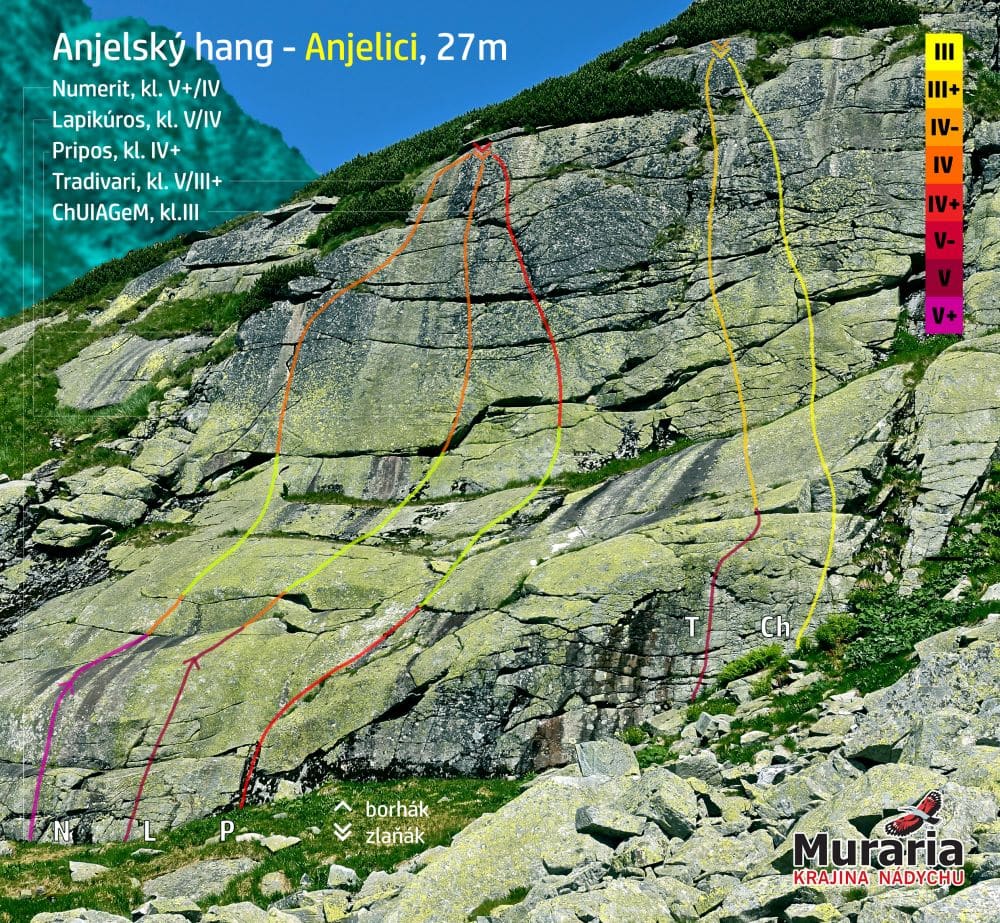
Stena Anjelikov - Anjelský hang 1919 m
The best spot in the High Tatras to practice climbing on your own protection
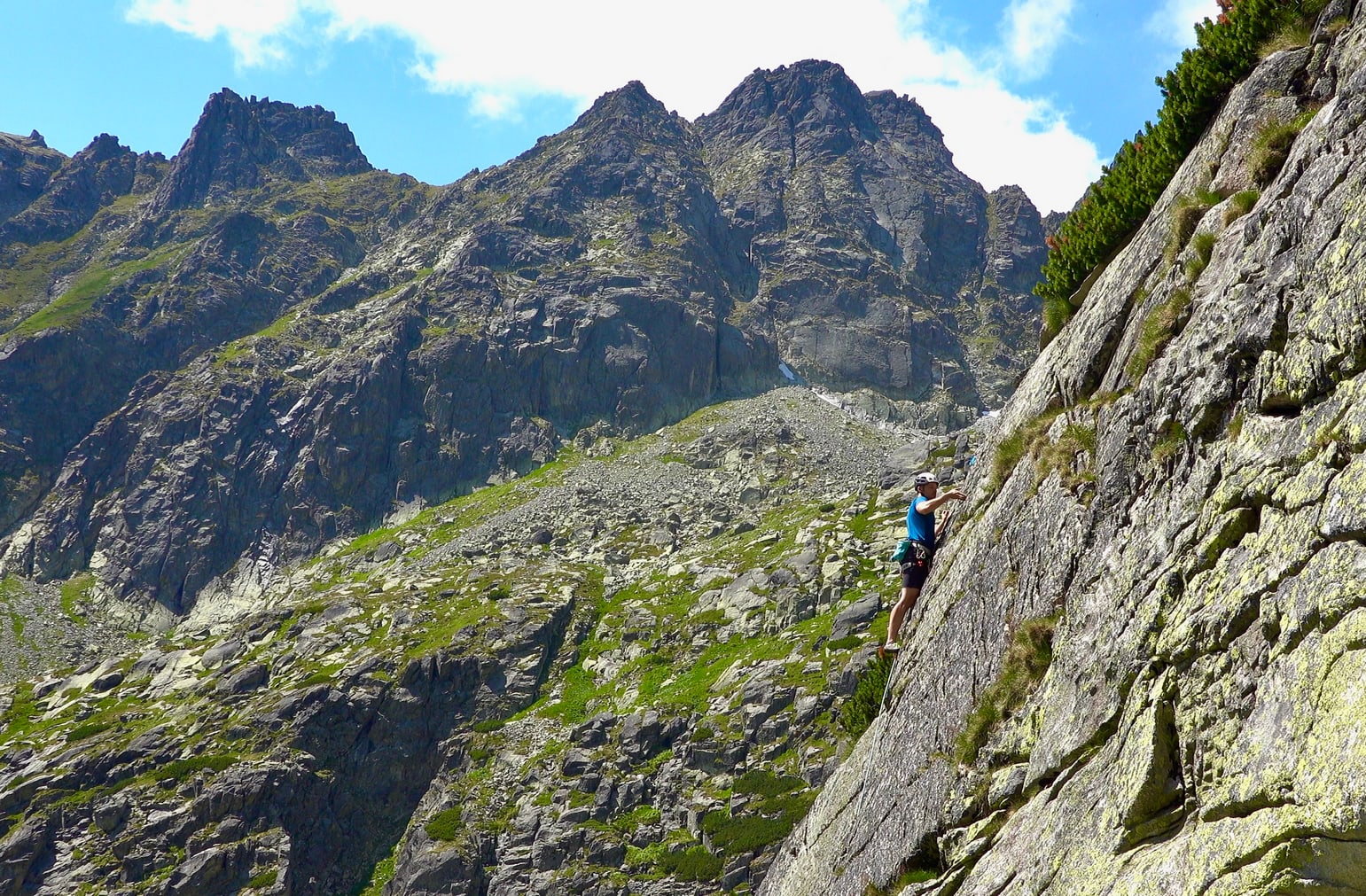
A "low-angle" 30-metre-tall wall to the left of Stena archanjelov. It faces southeast, and five routes run up it, meeting at the top in two anchors. Apart from two bolts on Numerit and Lapikúros, which form the first piece of protection on each, every route runs entirely on your own gear. The granite here is nicely shaped and compact too, offering excellent options for placing cams. If you have no climbing experience in the Tatras yet, start by climbing the "little angels." All five lines have their own charm - there isn't an uninteresting or unattractive route among them. Getting to know each "little angel" personally will help you understand climbing that much better. Strength isn't needed here - it's climbed "on your feet." What matters is the ability to read the rock and find your own way of solving it. Meeting each of the "little angels" and unraveling their secret will certainly leave you more confident when you climb. The route names are a light-hearted typology of Tatra climbers - knowing it can help you get your bearings on the subject, and can even help improve safety when moving through the mountains.
Characteristics
Five fun single pitches from grade III+ to V+, for those learning to place their own protection
Easy approach, gorgeous monolithic rock, and a variety of climbing from III+ to V+. Detailed route descriptions, plus a light-hearted introduction to climber typology - that's Stienka anjelikov. Climbing them is the "primer" for every beginning Tatra climber.
Anjelský hang opens up new possibilities in Mlynická dolina:
- for climbers, combined with climbing the Protiprúd route through the Skok waterfall;
- for hikers, with a crossing of the Bystrá footbridge, or an ascent of Satan or Štrbský štít.
South-facing:
The genuinely enjoyable character of this spot also owes a lot to the south-facing walls. The slope sits high enough above the temperature inversions (the clouds stay below it), while still being close enough for a comfortable trip home (while it's still light out).
Approach via Mlynická dolina (1:30 h):
The initial section is the same as the approach to Protiprúd.
Mlynická dolina is one of the most beautiful valleys in the Tatras. Looking more closely from the shores of Štrbské Pleso, its main features are easy to make out: the Solisko ridge borders it on the left, and the Bášte ridge on the right, while Štrbský štít closes it off at the far end. The floor of the valley rises steeply in three steps. The first step, framed on the right by Veža and Stena pod Skokom, is the Skok waterfall. The second is Anjelský hang itself. At the far end, the south rib of Štrbský štít and the surrounding little walls raise the valley floor, forming the Mlynický and Štrbský basins. Between the first and final steps mentioned lies a rocky slope. The yellow trail markers skirt it on the left, past Nižné volie pliesko. At the top of this slope is the start of the easiest route to the highest peak of the Bášte ridge - Satan - and the surrounding place names match: Satan, Pekelník (Hellion), Diablovina (Devilry), Čertov hrb (Devil's Hump), and on top of that, the Horned, Goat, and Ox tarns. But even the ruler of hell was created as an angel, and only worked his way to his current status - as a child of light he used to play with his peers, the angels. Probably only once he traded his wings for horns did his mobility shrink so much that he's stuck poking up out of the valley as a 2,422-metre-tall giant. Perhaps thanks to that, we managed to discover this angelic playground, formed of exceptionally solid, beautifully shaped granite. We named it Anjelský hang. It's made up of Stena archanjelov (90 m), Vežička padlých anjelov (40 m), and Stienka anjelikov (30 m). Nineteen pitches here make up twelve routes, from grade III to grade VI+. All of them can be climbed "light" - no pack, no approach shoes for the descent, and none of life's other accumulated baggage. You can rappel the routes comfortably straight down to the start. For those who want to enjoy the romantic little summit meadows where you can lie down, there's one more bolt at the top of the slope - right above it is an excellent flake, perfect for a 120 cm sling. An ideal combination for an anchor.
In German-speaking areas, a spot like this is called a "Kletterngarten." Well, know that in this little garden you'll find a ninety-metre-high crag facing south. Climbing here calls for placing your own protection, but bolts show up at just the right time, in just the right places. Come try it out. From Štrbské Pleso it's an hour and a half on foot to the base of the wall - a hiking trail marked in yellow, starting at the valley station of the Solisko chairlift. Not all trails are alike, though - judge for yourself: first through the forest, then through a dwarf-pine grove with a babbling stream, past imposing towers, up to a small azure-coloured tarn. Its shore is a beach of white sand. From there, either straight up through the waterfall via Protiprúd, grade III, or along the marked trail to the left around the waterfall, up to the large lake above Skok - Anjelský hang is mirrored in it. Then you have to hop across rocks jutting out of the stream, past a small waterfall, up to Zadná mlynická poľana with its huge boulders. Shortly past the spot where the little stream disappears underground, there's a turnoff toward the angels, marked by a cairn on a boulder. The path is lined with a wealth of mountain flowers - white pasque flowers, yellow arnica, blue harebells, purple soldanellas, and many more. If you don't want to socialize with hikers, set out at dawn - that's when you'll see chamois and maybe even marmots. Two ravens tend to fly above the slope. If possible, avoid starting the approach between 10 a.m. and 2 p.m. Come - the traces of your blueberry-and-jam-stained fingers will fade after your visit, but what you lived through stays forever.
First, a short reflection on Stienka anjelikov:
When I started climbing years ago, I thought climbers were people of solid character and good will. I was lucky, because I really did get to meet plenty like that. But with more and more years in the mountains, I gradually realized that the climbing community is far more varied in personality than that. Every so often I've even overheard someone say about a person: "Now that's a real little angel!" I found out that in life, it isn't only seraphim who help us, and only devils who tempt us - people do both those things too. Sometimes so perfectly that we consider them almost "divine." Those people can then shape us profoundly, for better or worse.
The following five single-pitch routes are dedicated to exactly these kinds of "little angels." Their lines run up a thirty-metre-tall wall to the left of the archangels.
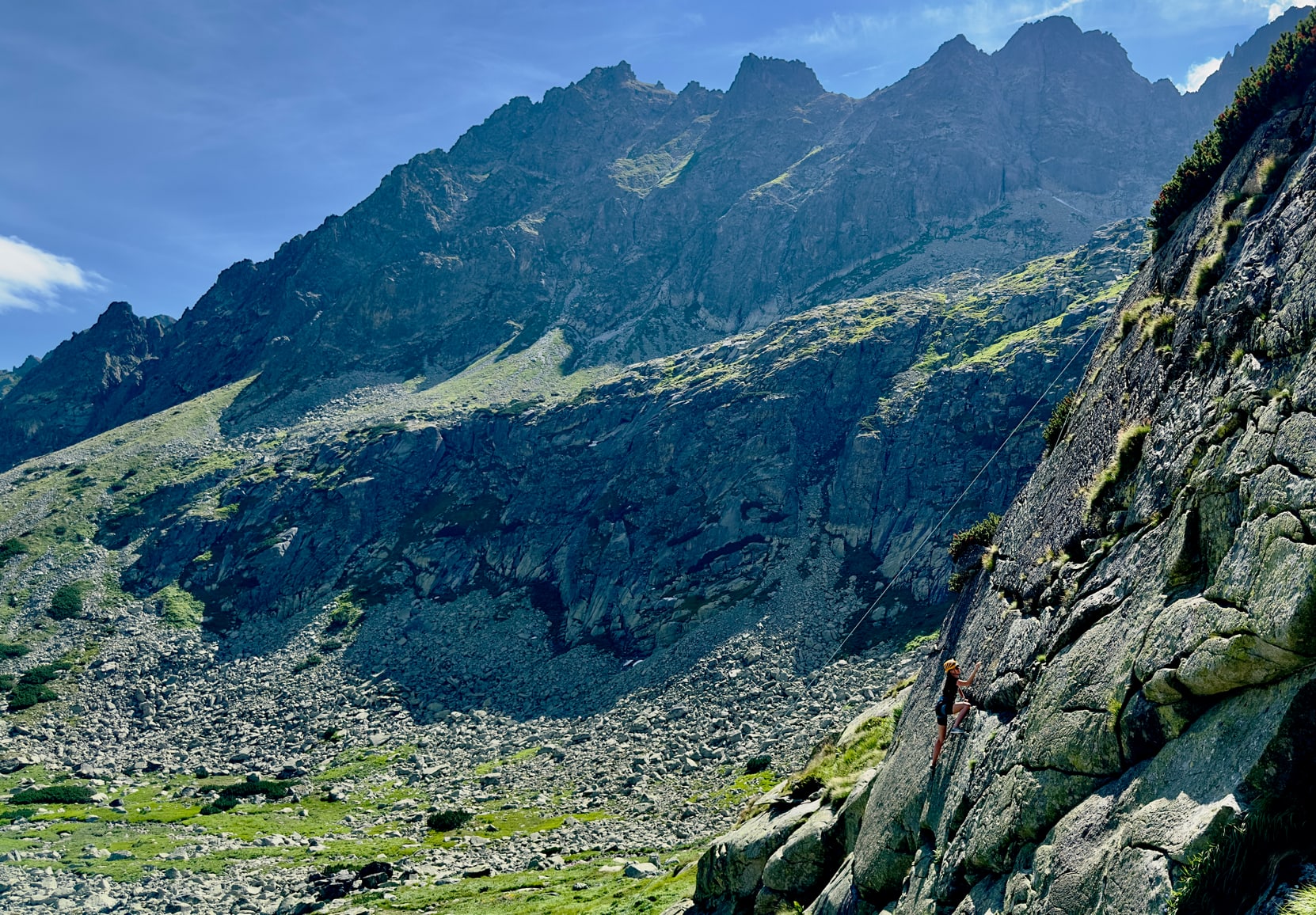
Descriptions of the individual routes:
1. Numerit, grade V+/IV, bolt at pitch 1, 28 m
A grade-four route with an opening friction-climbing section (V+, the bolt all the way on the left) and a lightning-bolt-shaped crack (IV) - this is the story of Numerit. For him, the mountains mean numbers. His symbols are a stopwatch and a grading scale. He's always tracking time, metres of elevation, number of trips, altitude, and above all, difficulty. He's happy to use rivets, but only if they boost his personal performance. Life is a race - nothing else really matters. Once his climbing performance declines, he often carries on as an official or a businessman, convinced he deserves to be respected as a leader. His name is built from the words "numero" and "to measure" - though I've also heard another interpretation: that he understood even the road to the Heavenly Father as a competition. He decided to take the direct line and be the first to bow before Him, and he arranged everything around that goal - training, diet, lifestyle. He even sacrificed his health and his family for it. Once he finally stood at the highest point, fingers frostbitten and brain swelling from altitude, the clouds really did start to part. Utterly exhausted, Numerit eagerly watched for the moment God's face would appear to praise his amazing achievement. But Saint Paul was already there ahead of him, and as Paul bowed before God, all that peeked out of his robe into the clouds was his backside. It's hard to say what really happened, but the fact remains that everyone knows the saying "Paul's backside."
Paul's Backside - a boulder of that very shape, with a dwarf-pine "robe" on top, sits five metres below the anchor, on the left. Better not touch it! No point tempting the heavenly powers...
If you haven't found your inner Numerit, skirt the V+ section two metres to the left of the bolt (IV-).
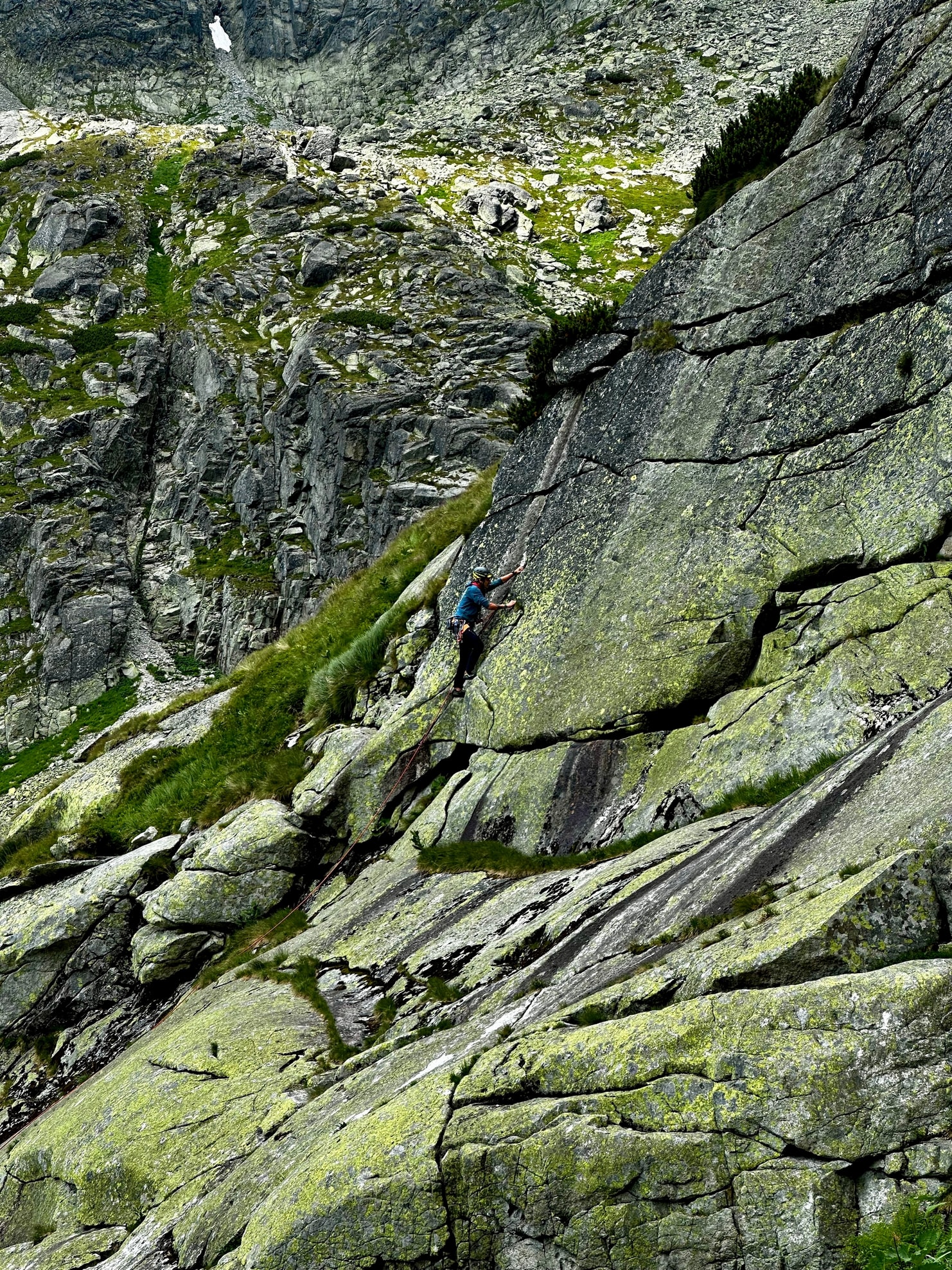
2. Lapikúros, grade V/IV, bolt at pitch 1, 28 m
This is the line that follows gorgeous rounded features (V, the second bolt from the left), a small wall (IV), and "sidelong" cracks (IV). It's the route of the little angel who, instead of wings, rides a bird of a roosterish temperament - he flies wildly, but only on his own rooster. Sadly, probably from the strain of all his acrobatic stunts, Lapikúros often suffers lapses in judgment and character - though he makes up for this shortcoming with his exceptional friendliness toward female climbers. He's always happy to give advice, lend gear, bring a gift, or at least let them in on his private bouldering spot. When needed, he readily steps in for a missing climbing partner, and he'll even sacrifice himself for a bivouac. He can be a brilliant climber - his signature trait is often finding a little crack good for a placement exactly where no one would expect one. He's proud of that, and it brings him a lot of joy while climbing.
Not everyone finds him likable, though. Long-haul aviators claim that a rooster's hops can't really be called flying - they're convinced that anyone who spends their whole life just hopping around knows nothing about real altitude, and on that basis they demote him to a lowly little angel - a mere pseudo-guardian. Either way, if you ever get the chance to watch Lapikúros in his typical flight for a while, notice that it's actually the rooster flying with him, not the other way around.
If you don't yet know how to friction-climb the rounded features (V), start up the Pripos route instead (III+).
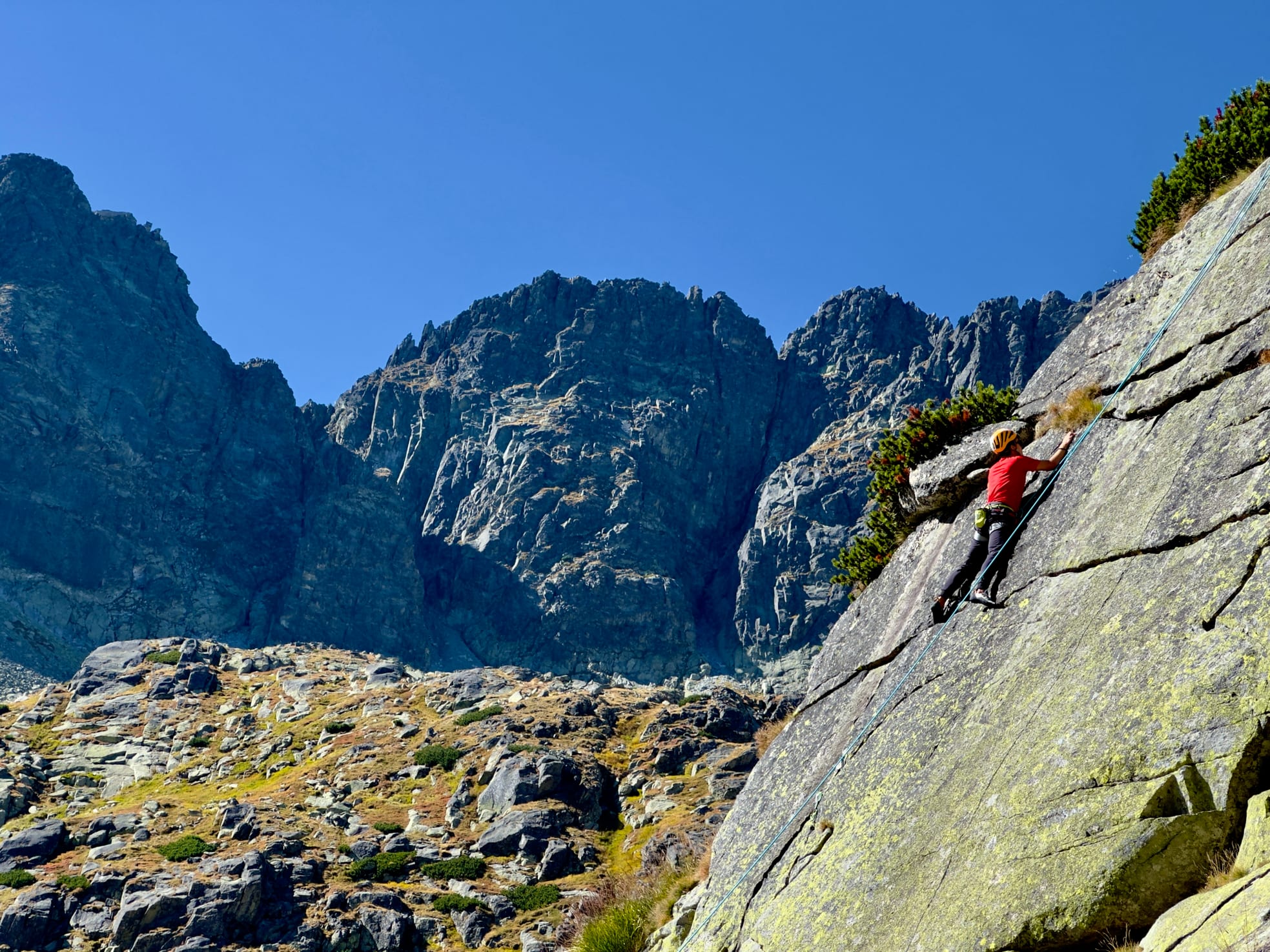
3. Pripos, grade IV+, 28 m
First a diagonal rounded ledge running left to right (III+), then a diagonal crack running right to left up to the anchor - that's the route of Pripos, a putto, a relative of the angels. He's a friend and a messenger of hope. He treats climbing almost as sacred. When working out and jogging, he always has his climbing goals in mind. His gear is always prepared and neatly packed, his helmet sprayed with a motivational slogan. His snacking is sufficient. His privilege is knowledge from internet tutorials. When it's time to climb, he resembles someone possessed. His current posture suggests that terror awaits the unprepared!
He presses himself against the wall and - doesn't move, just moans a little too much. On his last climb, after all, he landed bruised. He remembers, and quietly reassures himself: "Worst case, I'll just sit back on the bolt. I'll clip in and they'll lower me down. I won't climb too high, less will be enough for me." He looks the wall over more closely. There's no protection ahead. "Safety first! Not today."
Crude mockers are the source of Pripos's grief and ridicule - what else can you call people who claim he's simply overweight and scared?
Pripos mainly obeys authority, but that doesn't do much for his inner confidence, since every authority - Numerit, Tradivari, and ChUIAGeM alike - says something different, and of course, none of them recognize each other. So which one of them is the real leader?
4. Tradivari, grade V/III+, 28 m
Tufts of grass poking out of a crack (III+) leading straight to the anchor - who would turn their nose up at a climb like that? A traditionalist, perhaps? Without a doubt! But don't assume that's because he can't climb - the start, up a slightly overhanging wall (V), where you need to place a cam in the crack on the left, proves the opposite on this route. With his hammer, Tradivari guards the legacy of our forebears. His knowledge of the Tatras can be excellent - in the Pavúkov routes, for instance, he can tell apart the pitons driven in by Ondrej from the ones driven in by Pavol. His literary foundation is made up of multi-volume books and articles with the initials AP, FK, WHP, JA, WC, JG, IB, and MB. If those letters only "rang a bell" for you at JA and WC, better not even start a conversation with him. Don't provoke him needlessly with a chalk bag either - greet him respectfully and wait to see if he addresses you first. Offering him a few sips of water usually helps break the ice - the fiery kind, of course. If he takes an interest in you after that, never use the word "bolt" around him. Know that it's definitely worth becoming friends with him - you'll find topos of several of his routes in the summit logbooks at mountain huts, and while studying them, or looking through photos of them, you can safely put on some Rolling Stones in the background. But the most thrilling thing of all is getting an invitation from Tradivari for a climb together - only then will you finally get to experience, firsthand, that unforgettable feeling of building an anchor on thick lichen, or rappelling off frozen chamois droppings.
If you don't feel up to the opening overhang (V), start instead from the ChUIAGeM route (III).
5. ChUIAGeM, grade III
The easiest of all the routes, running first up "little steps" from left to right, then up a wall with cracks from right to left to the anchor, represents absolute heroism. It's a story of apotheosis, showing how an ordinary person can become a god, or at least a demigod. ChUIAGeM was once a boy who climbed and skied brilliantly. He longed for those two activities to become his profession, and he realized that a miraculous silver badge could help him get there - so he did a great deal to earn it. And indeed, the moment he succeeded, he felt an extraordinary power, as if he'd suddenly become the absolute master of the Tatras. Gerlach itself became his domain - no one else was allowed there. But like the Hercules of old, he too faced a long list of difficult tasks. Every morning, before dawn, he'd start running so he'd be first on the summit, fearlessly destroying everything standing in the way of his graduation. First it was the stone cairns - they fell first, and not one was left on Gerlach. Then he mercilessly threw the chains down into the valley too, since they, just like the cairns, had been helping free people find their way up and down. Order needed to be restored across the whole Tatras, not just on Gerlach, so he threw the chains off Lomnický štít and Baranie rohy too. Stone cairns kept disappearing. Next he had to defeat the monster called Legislation - only that could guarantee that, off the marked trails, people could move only in the company of a ChUIAGeM. It was a very demanding task, one only someone who'd won favour in the garden of the Bigwigs could pull off. He had to speak, ostensibly, in the name of safety and nature conservation - and he managed that too. Just when it seemed everything was won, he learned some very bad news: besides him, there were plenty of other ChUIAGeMs, and every single one of them thought the Tatras belonged only to them. A merciless duel began - ChUIAGeM against ChUIAGeM, and ChUIAGeMs against ChUIAGeMs. A brutal battle even played out right below the summit of Gerlach itself - a Slovak ChUIAGeM fought a Polish ChUIAGeMica. Punches were thrown, kicks were landed with crampons - this thrilling duel, played out in front of their own clients, was quite a sight. Slovakia remains the only country in Europe where high-mountain hikers can move off the marked trails only with a ChUIAGeM or a special certificate. But the fight isn't over - mysterious phantoms still roam the peaks and valleys: the dark guides.
It's important to note that not everyone who owns the miraculous silver badge becomes a demigod - a ChUIAGeM. It takes persistent work to get there - I know a few who kept that badge and still stayed human.
One last word
No one is perfect - not even the "little angels" who are such an inseparable part of climbing. If you now have the impression that everyone else is a joke and I alone remain the ideal, I have to disappoint you - that isn't the case. Without the Numerits, climbing would have stayed stuck somewhere around grade three - it would lose one of its essential elements, which is overcoming the impossible. Thanks to the Lapikúroses, we're more aware that the "spark" between the sexes is one of the phenomena driving the world forward - and it's good to know that this force is at work in climbing too. When a man and a woman climb together, three possibilities usually apply: either it was already there, it's still there, or it's yet to come. The Priposes, meanwhile, sometimes help us stay uninjured, or even survive. They also remind us that life isn't just about counting calories and chasing bigger numbers - a good dinner, dessert included, after climbing is one of the magical moments of the day. Tradivari and his crew protect the sense of adventure in climbing - without him it would start to resemble an ordinary gym workout. And the ChUIAGeMs are a warning, a reminder of how easily basic ethical principles about freedom and friendship in the mountains can be abandoned for money and power. Not everyone should be lumped together, though - I know guides among them too whom I genuinely respect.
And one more important note: if you recognized a specific person among the "little angels" described here, know that any resemblance is purely coincidental. The one exception might be if that person is you yourself. There's no need to bow down to angels, and even less so to "little angels" - but it's good to be close to them. And if you grew up on the same playground, then there's only a small step left toward getting closer still. So come climb Anjelský hang!
Time required
- Štrbské Pleso – Anjelský hang: 1 hour 30 minutes
- The climb: depending on the routes chosen
- Return to Štrbské Pleso: 1 hour 30 minutes
These times apply to a two-person climbing team. For a party of three, or for beginners, it may take several hours longer!
Gear
- a sit harness and chest harness
- a helmet
- a single 60 m rope
- 10 quickdraws
- 2 x 120 cm slings
- 4 locking carabiners
- 2 locking HMS carabiners
- a belay/rappel device for each climber (for example a Gigi or a Jul)
- 10 cams - basic as well as small sizes, or nuts with a nut tool
- climbing shoes
- a first-aid kit with a thermal reflective blanket
- a headlamp
- enough fluids
- food for the field
- clothing to protect against cold and rain
- a mobile phone with a charged battery
- topos and route descriptions
This page has been translated using AI and may contain errors.