
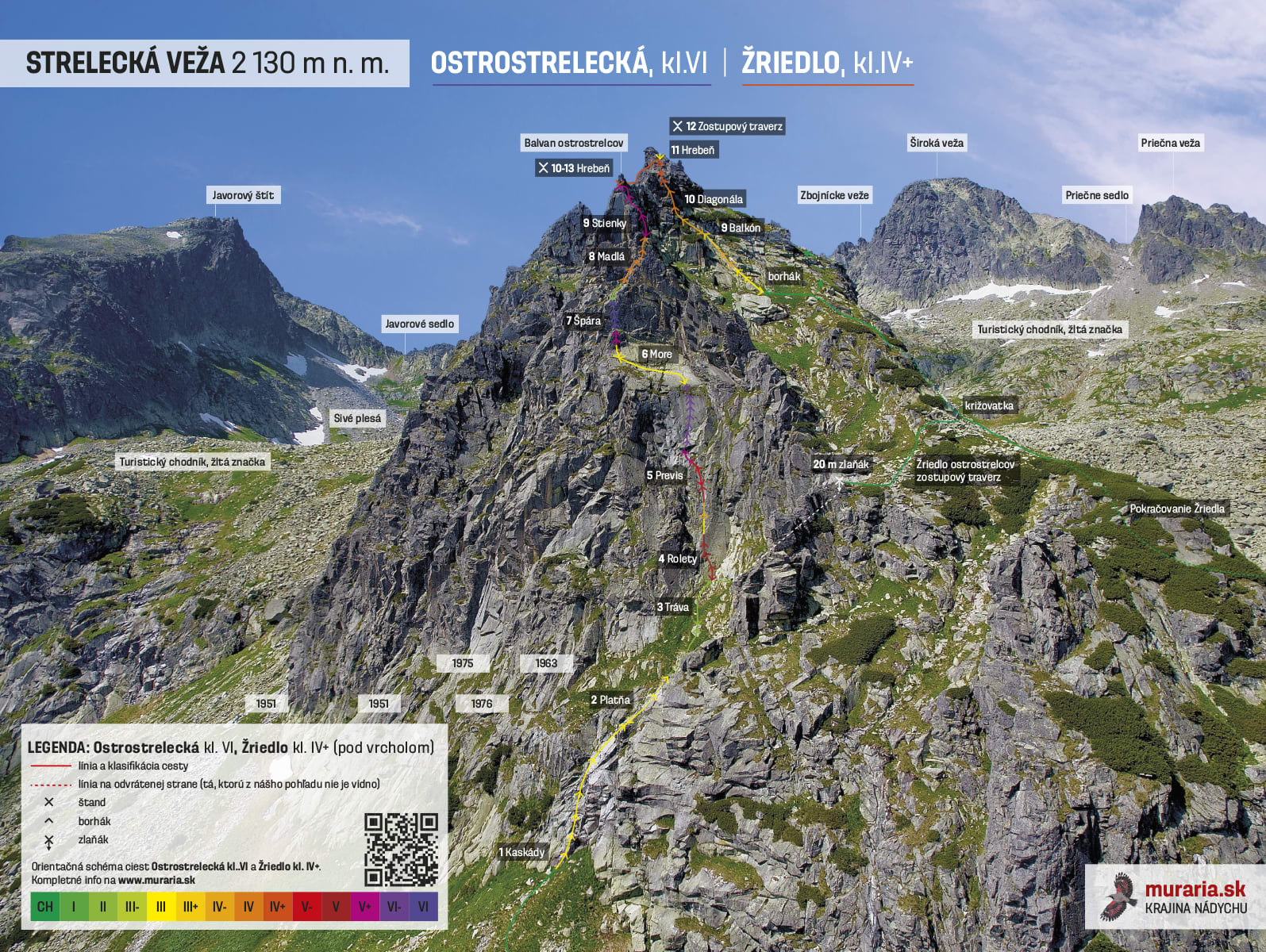
Žriedlo, grade IV+, Strelecká veža 2130 m, 12 pitches
A route on unique rock, running up two waterfalls and their source, all the way to the summit. The Žriedlo route was made possible with support from TMR.
Characteristics
A unique route for a great Tatra mountaineering adventure
Grade three marks the beginning of real climbing. That's exactly what this route is about. The only exceptions are two spots graded IV- and IV+, the harder of which, by convention, sets the route's overall difficulty. Despite its initiatory grade, the whole climb has the character of a serious mountaineering tour. Climbers need to judge whether conditions suit the climb, handle considerable route-finding complexity, know multi-pitch technique, and, on top of that, know how to place their own protection too. They also need to plan their time well, since there are twelve pitches to climb. The whole line runs through unique terrain on amazing rock. No route like it exists anywhere else in the Tatras. Doubt it? Then try picturing a climbing route where you first climb a 38-metre waterfall, then climb, and even jump across, a second one, 78 metres tall. Search your memory, or the guidebooks, for a climb with a waterfall's source, from which you can drink on the eighth pitch - the very spot where it all begins, since above it there's no more surface flow at all. Try to find a tour to a glacial nunatak from where you can see more than fifteen tarns. A summit tower that, despite its airy finale, you descend without protection, on safe walking terrain.
Optional length and difficulty
The variable length and difficulty suit the climb to several categories of both climbers and non-climbers. The mountaineering tour builds in intensity - meaning each of the three sections of the climb (Nižný strelecký vodopád, grade III; Vyšný strelecký vodopád, grade IV-; and the summit, grade IV+), after which you can descend on walking terrain, rises in difficulty. The climb is considerably harder than Protiprúd at the Skok waterfall. Its complexity demands more even than Jubilejná on Velický zub, even though the climbing itself is roughly comparable. Hikers and via-ferrata enthusiasts definitely need the company of a professional, or an experienced and responsible climber.
Miraculous living water for injured and timid climbers
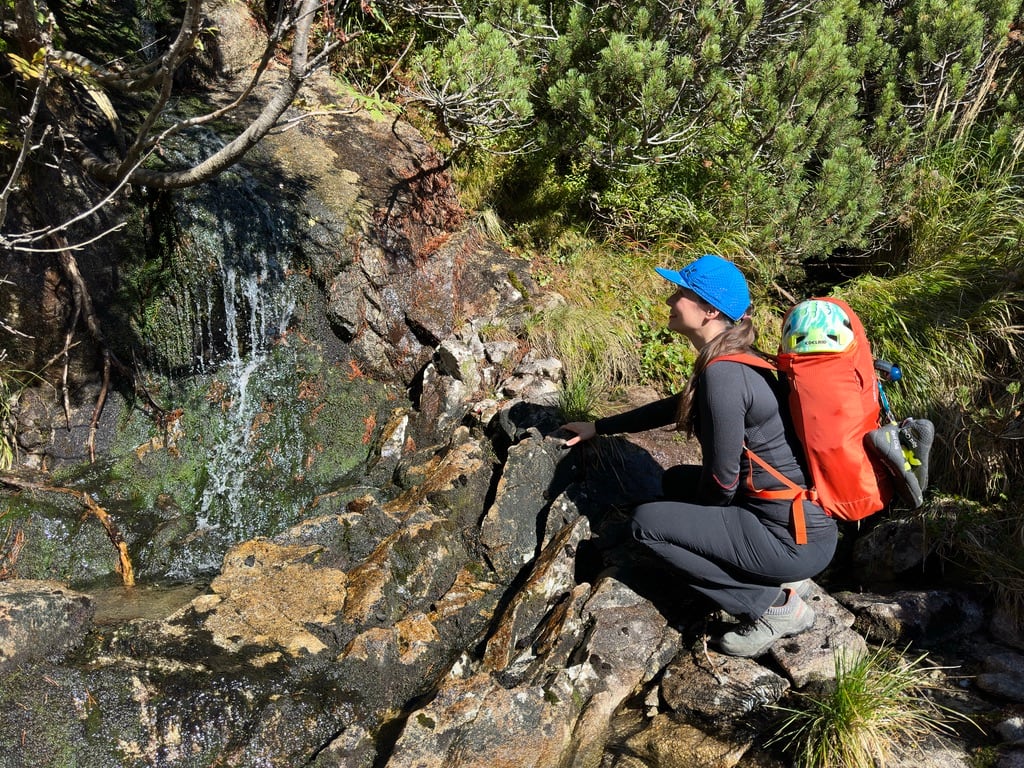
Throughout the route, the placement of fixed protection is encouraging and helps with orientation. The spots for "placing" your own gear are excellent and well described in the text. Every anchor sits on two stainless-steel bolts connected by a chain. Drinking water straight from the spring itself has a healing power. The water rises here directly out of the ground, at nearly two thousand metres, with no surface tributary at all. It's completely clear, with a delicate, soft taste. Analysis has shown no signs of pollution whatsoever. Nitrates and nitrites sit well below the limits. It contains just enough calcium to give it lightness, but not hardness. It's gentle on the kidneys. When you drink it, you get the feeling you're drinking pure mountain air turned to water. That's exactly why you should never bivouac above Žriedlo! Don't pollute the surroundings! Carry your trash and cigarette butts out with you! Relieve yourself far from the spring, and think about which way the slope drains. Careless behaviour can very easily and very quickly destroy this mountain gem! This water has stayed clean because people haven't been near it. Within a single season of people disregarding the rules, it could become contaminated.
Žriedlo and the Ostrostrelecká route combine in interesting ways:
- Ostrostrelcká cez Žriedlo, grade VI, 18+ pitches, Strelecká veža 2130 m This Tatra mountaineering epic is created by climbing the Žriedlo route up to the source of the waterfalls, then joining onto the third pitch of the Ostrostrelecká route.
From there we continue as on the Žriedlo route. At roughly 2000 metres of elevation there's a junction. Toward the Žriedlo-to-Ostrostrelci variant we continue left, to the southwest. The direction of the descent is marked by quartz pebbles on cairns. We reach the rappel station. It's a piton connected by a chain to a glue-in bolt with a "ram's head." From there you can see the anchor bolt for the fourth pitch of Ostrostrelecká. It's an ideal spot to survey almost the whole route. A 40-metre rappel gets us straight down to this anchor bolt. With a shorter rope, after 15 metres of rappelling down the wall and an overhang, we reach the anchor on foot (grade I). The terrain is a gully filled with rocks, and lower down, steep grass. You can downclimb the whole gully to the anchor (grade II) without rappelling too. From the source to the rappel station takes 15 minutes.
- Ostrostrelcká cez Cieľnik, grade VI, 12 pitches, Strelecká veža 2130 m The most direct combination of the two routes mentioned. It's created by climbing Nižný strelecký vodopád (the first three pitches of that route). From the top of the waterfall we reach the start of Ostrostrelecká on walking terrain in 15 minutes. A beautiful, logical variant of Ostrostrelecká. If we want to climb up to Balvan ostrostrelcov, this option lets us climb the easy pitches with a pack, but the harder ones without it.
- Cez Mušku, grade IV-, 5 pitches, Žriedlo 1939 m A one-act version created by approaching from Studené plesá and climbing only Vyšný strelecký vodopád. Skipping the first three pitches makes the tour less interesting, but it can be handy as a short tour for those staying at Zbojnícka chata.
- The Žriedlo route provides an alternative approach to Strelecké polia. After climbing the route, you can continue climbing in the Široká veža or Ostrý štít massifs.
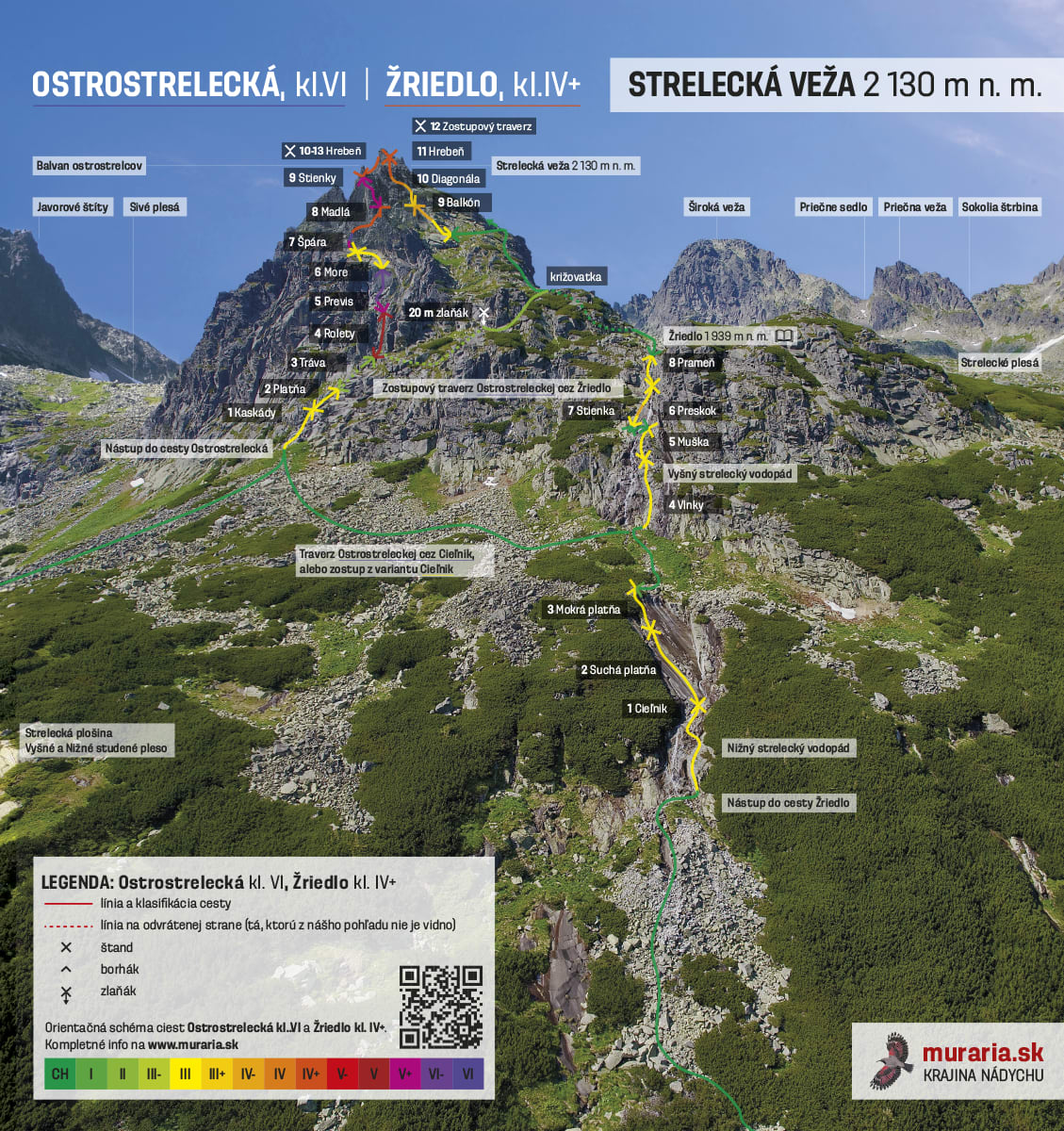
Approach via Veľká Studená dolina (1:45 h):
Following the blue trail markers toward Zbojnícka chata. Before the first boulder field, we leave the marked trail and turn 150 degrees to the right. From there we walk for a while along a chamois path marked with quartz pebbles, up to the moraine (cairns) leading below the waterfall. The route is marked on the mapy.com portal.
For those who like things in more detail, here's a full description of the approach too:
The easiest way to reach Nižný strelecký vodopád is from Starý Smokovec via Hrebienok. Horská ubytovňa Hrebienok is an ideal starting point, thanks to its location and its attractive price, which includes a return chairlift ticket. Even Queen Elizabeth of Britain once rode that lift. A bicycle, or e-bike, is an alternative - you can ride it along the main trail all the way to the junction above Rainerova chata, where you'll need to solve the small dilemma of where to leave it. At the junction we turn off the main trail onto the blue-marked path leading into Veľká Studená dolina. The opening stretch runs through a windfall area, which does at least offer views of the Studenovodské vodopády waterfalls. The TANAP administration has left this forest untouched. The windstorm hit hardest lower down; higher up the forest is in better shape. Before the end of the forest we pass the turnoff to the ski-touring line Húpačky, and shortly after cross a wooden footbridge. Past it is a tiny hint of a meadow, from where you can watch the spray of Veverkov vodopád. You'll find it on the north face of Slavkovský štít. This 500-metre wall is most popular for its roughly ten rewarding ice climbs. The forest ends around here, and the view into the valley opens up. After a while the trail crosses the rocks of Groszov žľab. From this spot we get a good view of our destination. Strelecká veža is a nunatak, a remnant of glacial activity. Thanks to that it stands isolated in the middle of Veľká Studená dolina, with no connection at all to the ridges of the surrounding peaks. We continue along the blue trail and pass a boulder with winter trail poles. Higher up, a wooden bridge helps us cross Veľký Studený potok. It's still a pleasant, gentle climb. On the left, on the opposite side of the valley, we'll soon notice an orange boulder called Perníková chalúpka (Gingerbread House). On the same side, higher above it, is the boulder Ohnisko (Hearth). Around it is the El Diablo bouldering sector, along with a few short bolted routes ranging from 5c to 8c. The purely rocky surroundings of the trail at that same level soon give way to dwarf pines again. This brings us to a spot where the trail crosses rocks from Žľab nad Prostredným again. Above the upper part of this extreme ski terrain, the famous, distinct slabs of Malý hrot are visible. Right by the trail here is a boulder forming a bench, with a few rowan trees above it. This popular porters' rest stop is called Bufet. From here, back in the 1920s, a marked trail once branched off toward Strelecká kotlina and higher up to Strelecké polia. If we end our climb above the spring, that's exactly the way our descent will go. The remains of that once-built trail, though, now need to be searched for carefully. We continue along the blue trail until the point where, because of the steepness, the trail forms switchbacks. They turn left, right, and left again until we reach a stretch bordered on the right by small walls, down which the trickling little streams of the Žriedlo brook flow. Over a short stretch here, the trail built from laid stones gives way to glacially polished rock forming monolithic slabs of trail. Just before the first boulder field of polished rock, we turn right. A waterlogged grassy terrace here is closed off by a small rock wall. In it we find two inconspicuous natural steps in a crack between boulders. We climb them onto a water-worn ledge. On it sits a piece of quartz, roughly 15 x 17 cm. We turn about 150 degrees to the right. Along this ledge we continue in almost the exact opposite direction from the marked trail we were walking, for about 100 metres, climbing gently through grass. Because of the tall grass, the terrain here forms hard-to-see holes, so we walk carefully. From here on, our route will be accompanied by water continuously, until, after eight pitches, we climb up to the spring itself. Only above it does all that murmuring, babbling, and roaring finally stop. For now, though, on the approach, we don't follow the stream directly. We first turn left, more steeply upward, and alongside a wet little wall, then turn right again into a traverse along the contour. We reach a diagonal slab with a stream flowing across it. There are two pieces of quartz on it. We don't cross it, but turn left before it, steeply upward. Then we turn right again. Here the little stream forms a decorative garden waterfall. Only here do we cross to the other side of the stream and continue 10 metres through dwarf pines to a clearing. Here we again turn left, climbing steeply between boulders and dwarf pines. On one of them, two clearly recognizable stone footholds stand out. We climb onto the boulder and cross to the next one, right beside it. They're connected by a smaller stone wedged in a thick dwarf-pine branch. On the second, large boulder, a rope indicates the direction of travel. With its help we climb across to the opposite side of the boulder. Here we still zigzag a while between boulders, then continue along a stony moraine, from where Nižný strelecký vodopád, 38 metres tall, comes into view. The trail from here is well marked with cairns. On the stretch from the marked trail to the boulder with the two footholds, always follow the quartz pebbles! If you don't see any of them, you've gone off route. Go back to the last piece of quartz and look for the next one and the right direction!
Roughly 40 metres before the waterfall, in a rock slab forming part of our trail, is a "fossil" of a giant sperm whale. It's a 7-metre-long calf. Given that granite is a deep-magmatic rock that crystallizes at temperatures of 700 to 900°C, this is the only granite "fossil" in the world. It proves that millions of years ago, the Tatra tarns were probably larger, and home to whales, orcas, and dolphins too. More water flowed through the waterfalls back then, and these intelligent mammals sought them out for joy and personal fulfilment. The terrain of the Strelecké vodopády is a high-mountain environment. The 12-metre Muška tower above the fifth pitch merely leans against the rock wall. To the left of the seventh anchor, a block the size of two shipping containers simply rests on a diagonal slab. The rock of the Žriedlo route is exceptionally compact, but these are mountains. Like every mountain range in the world, the Tatras too are gradually crumbling. We'll never know today what happened to this calf, breathing with lungs and drinking its mother's milk. Take a moment here to think of your own young ones - real ones, and potential ones too. Look after your own safety! Some of these intelligent mammals, after all, are considered endangered species because of their behaviour and the environment they move through. Above the "whale fossil," the climbing has only just begun.
Route description
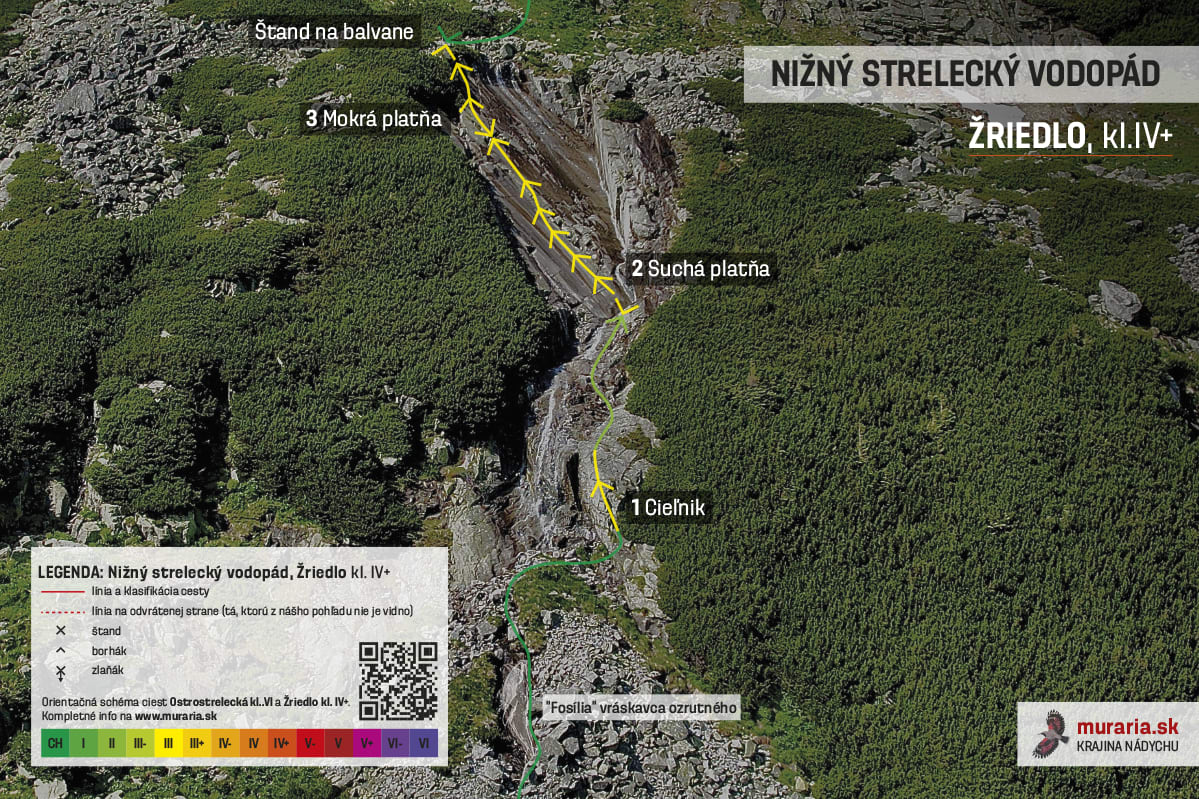
Pitch 1: Cieľnik, grade III, 30 m, 1 bolt
Nižný strelecký vodopád has a "warm-up act" in its lower part - a nine-metre-tall step. To the right of this water drop is a small pillar, which carries the opening metres of the route (grade III). At about 4 m is this pitch's only bolt. It's clearly visible from the start. Above the rise, the pillar loses its steepness. We proceed first to the right of the waterfall, then, after about 20 metres, up its middle (grade I/II), always staying on dry rock, to the Cieľnik anchor on a good ledge. Most of the water flows straight through its middle. The sharpshooter's view through the sights, Cieľnik-Muška - Muška being the little tower on Horný strelecký vodopád - is best from this very first anchor. Climbers can see each other only on the lower step. Because of the roar of the water, they can hear each other only to a limited extent. The anchor is visible from the top of the rock step, but not from the start.
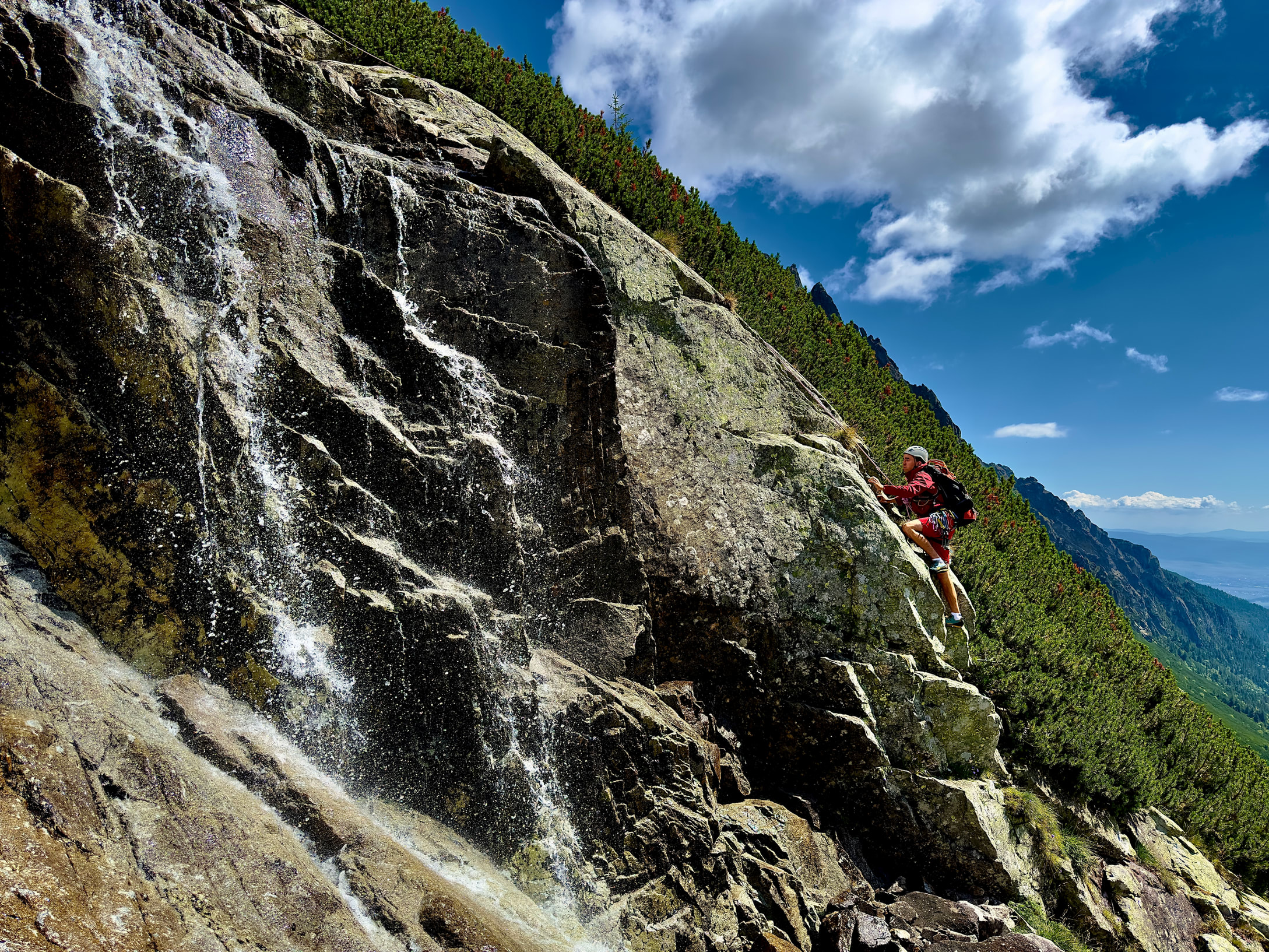
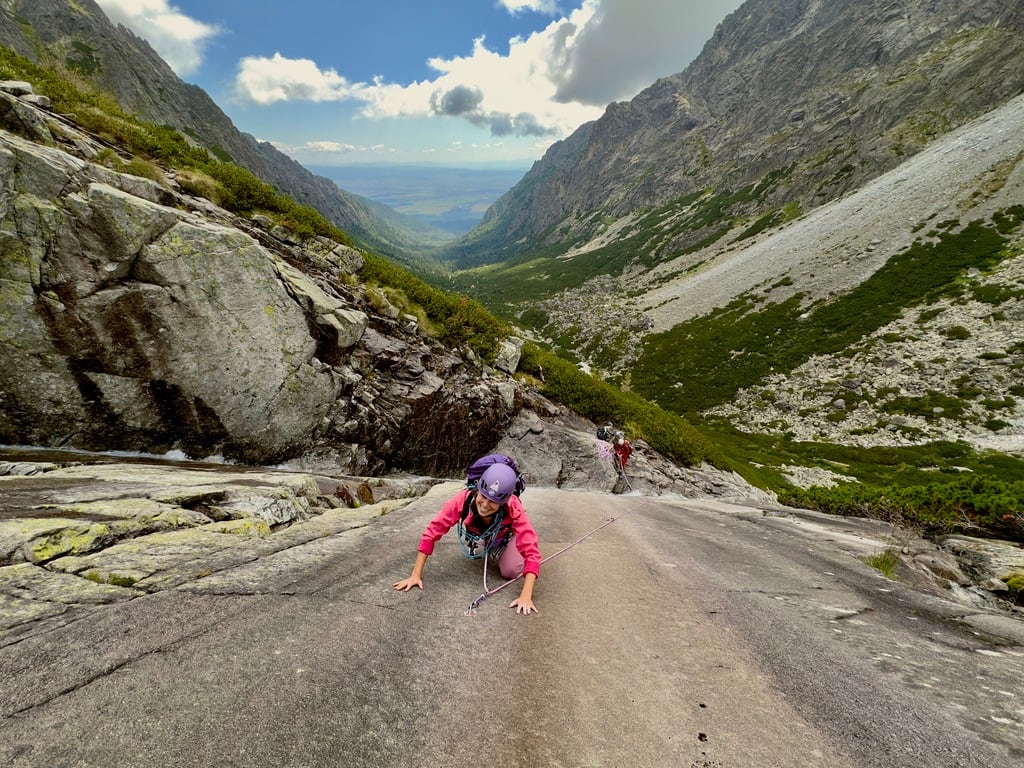
Pitch 2: Dry Slab, grade III (CH?), 33 m, 5 bolts
Arno Puškáš would probably have written of the following pitch: "We reach a wet slab with no holds, footholds, or cracks. Straight up it."
Looking up, on the left is a distinct, 45-metre rock slab, partly washed by water. Its steepest point sits at 47 degrees. The slab has a dry strip down its middle. Five bolts in it show the way to the anchor on a small ledge. Above B5 you can place good gear of your own. Climbers can see each other and, with a bit of effort, hear each other too. Sharp-eyed climbers can spot the second anchor. The character of the terrain, the unambiguous route-finding, and the good protection make this pitch ideal for Tatra debutants on the sharp end.
The whole second pitch can be walked across without using your hands - not everyone believes that, though.
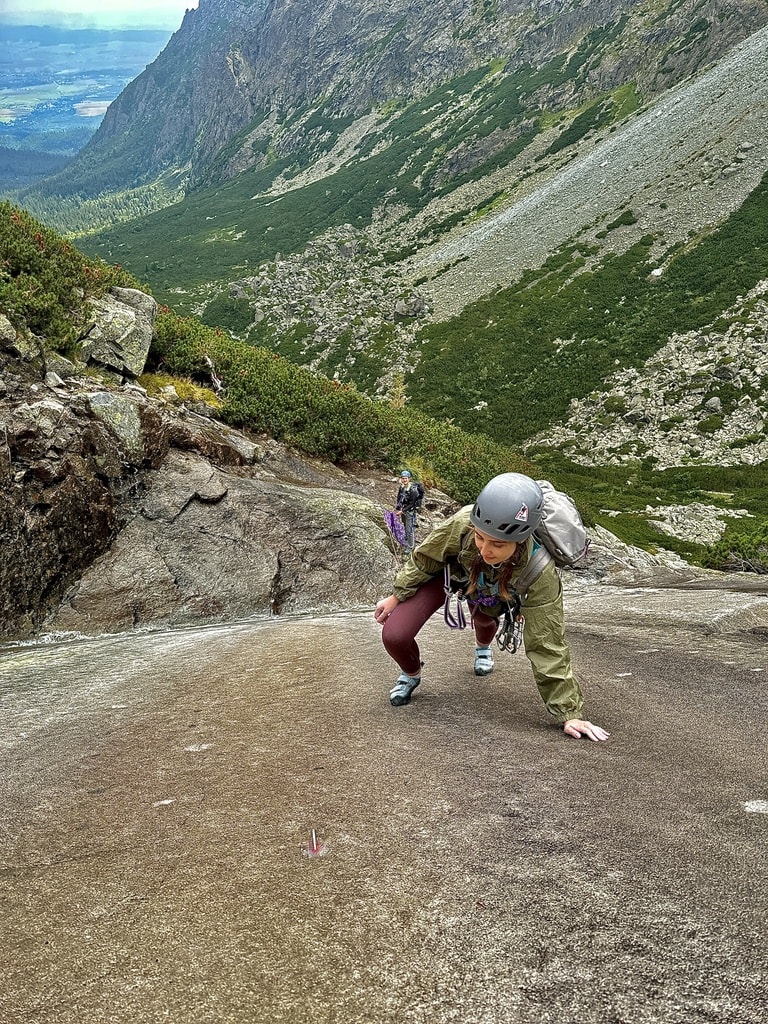
Pitch 3: Wet Slab, grade III, 18 m, 2 bolts
Up a crack to the edge of the dwarf pines on the left side of the slab, B1. From here, another 6 metres over usually flooded rock, B2, to a scree terrace above the waterfall. The anchor is formed by cord loops around a loose boulder - a "chockstone." Its weight is about three hundred and fifty kilos. If the cord is new, that also holds for the strength of the whole anchor. We therefore take in the second climber carefully. Dynamic loading of this anchor isn't a good idea! Never have more than one climber on the other end of the rope! Climbers can see each other only up to reaching the terrace above the waterfall. Anchor 3 isn't visible from Anchor 2. The protection bolts are partly hidden by dwarf pines.
Pitches 2 and 3 can be combined, but Cieľnik is a special spot. It's worth pausing there for a moment.
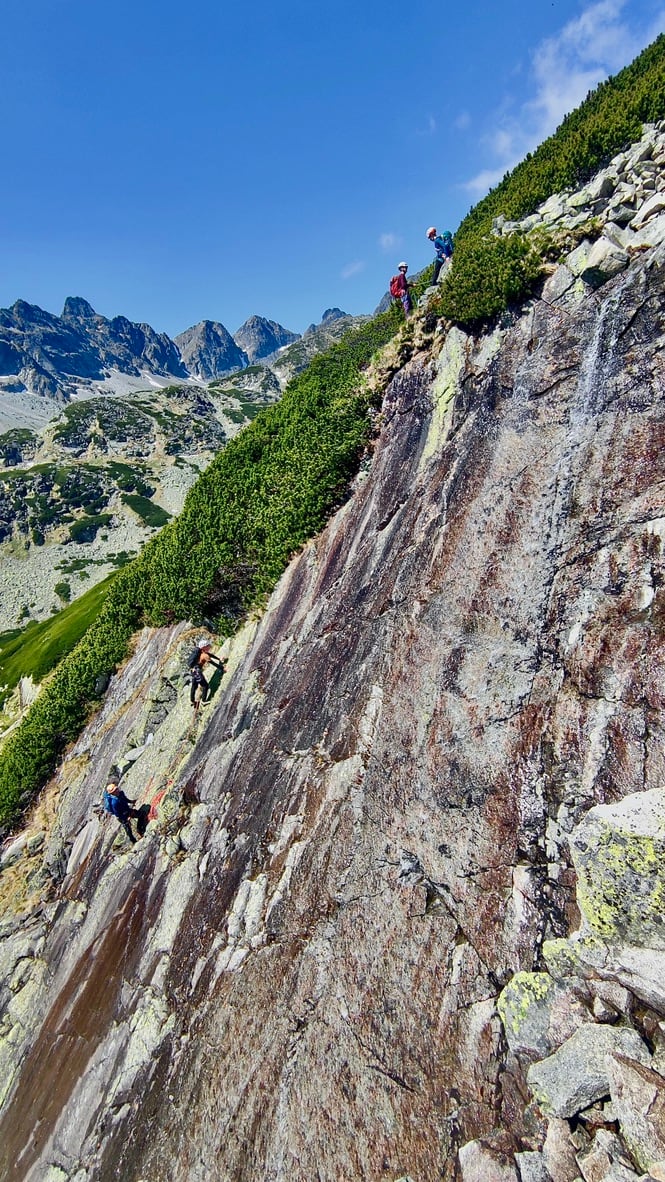
Walking terrain between the waterfalls
From the terrace above Nižný strelecký vodopád we cross (walking) over rocks and grass below Vyšný strelecký vodopád. Its height is 78 metres. The fourth climbing pitch is bounded by two streams of its falling water. The start is close to the right branch of the waterfall, where the protection bolts are clearly visible.
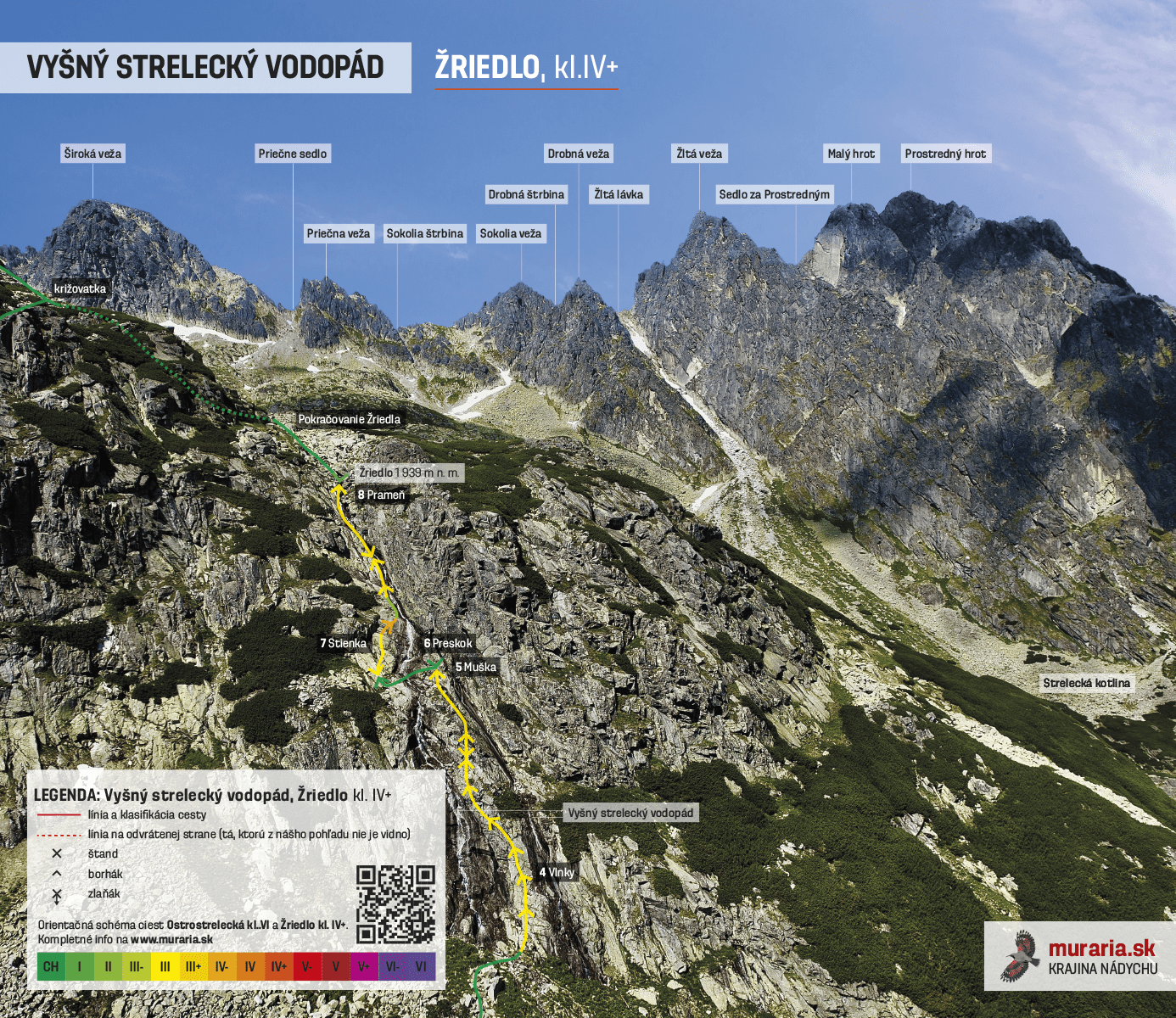
Pitch 4: Ripples, grade III-, 34 m, 5 bolts
The whole line of the pitch is marked by visible protection bolts. We climb straight up to B2. From there the route drifts, climbing across a surface of granite ripples, slightly left up to B4, where it comes very close to the waterfall's left stream. From B5 we continue straight up to a grassy ledge and the anchor.
Climbers can see each other the whole time. It's climbed on your feet. This pitch too is ideal for Tatra debutants. If that's you, don't hesitate - go lead it.
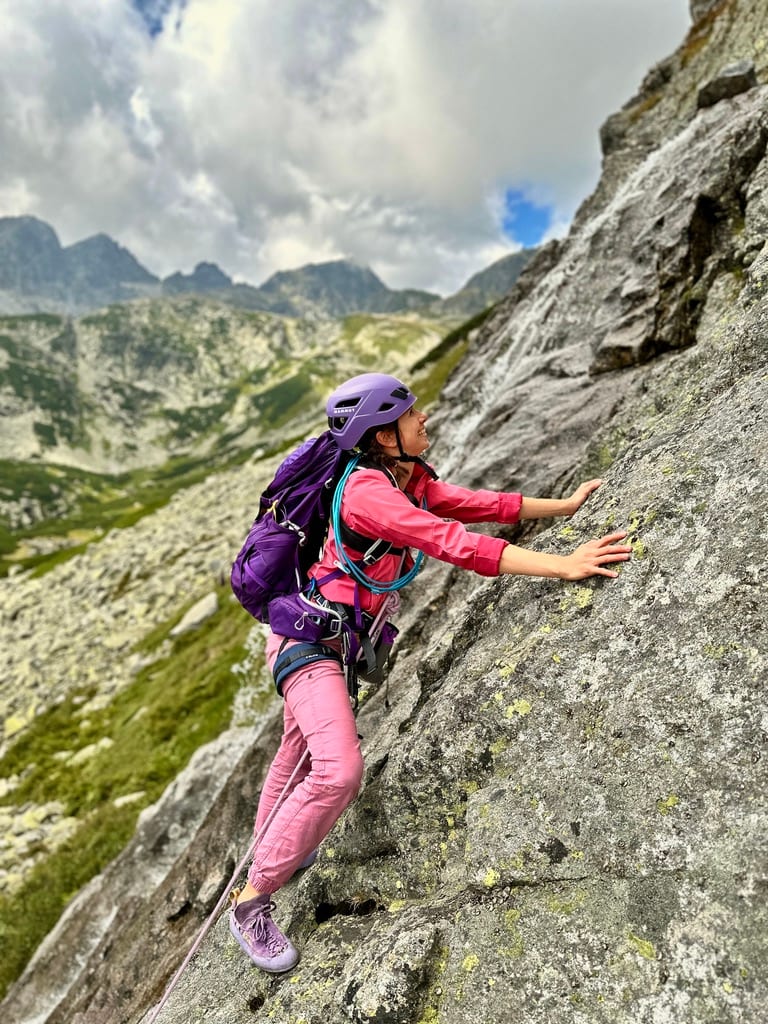
Pitch 5: Vežička Muška, grade III, 26 m, 1 bolt
From the anchor straight up, B1, then into a corner running diagonally left. There are excellent options there for placing cams. After 12 metres the corner brings us to a horizontal little ridge, along which, now on walking terrain, we reach the anchor set on a small pillar on the right side of the waterfall.
Climbers can see each other only up to the top of the corner. They can hear each other only to a limited extent. Anchor 5 isn't visible from Anchor 4. This anchor can be skipped, moving straight across to the other side, but the rope usually gets wet doing so.
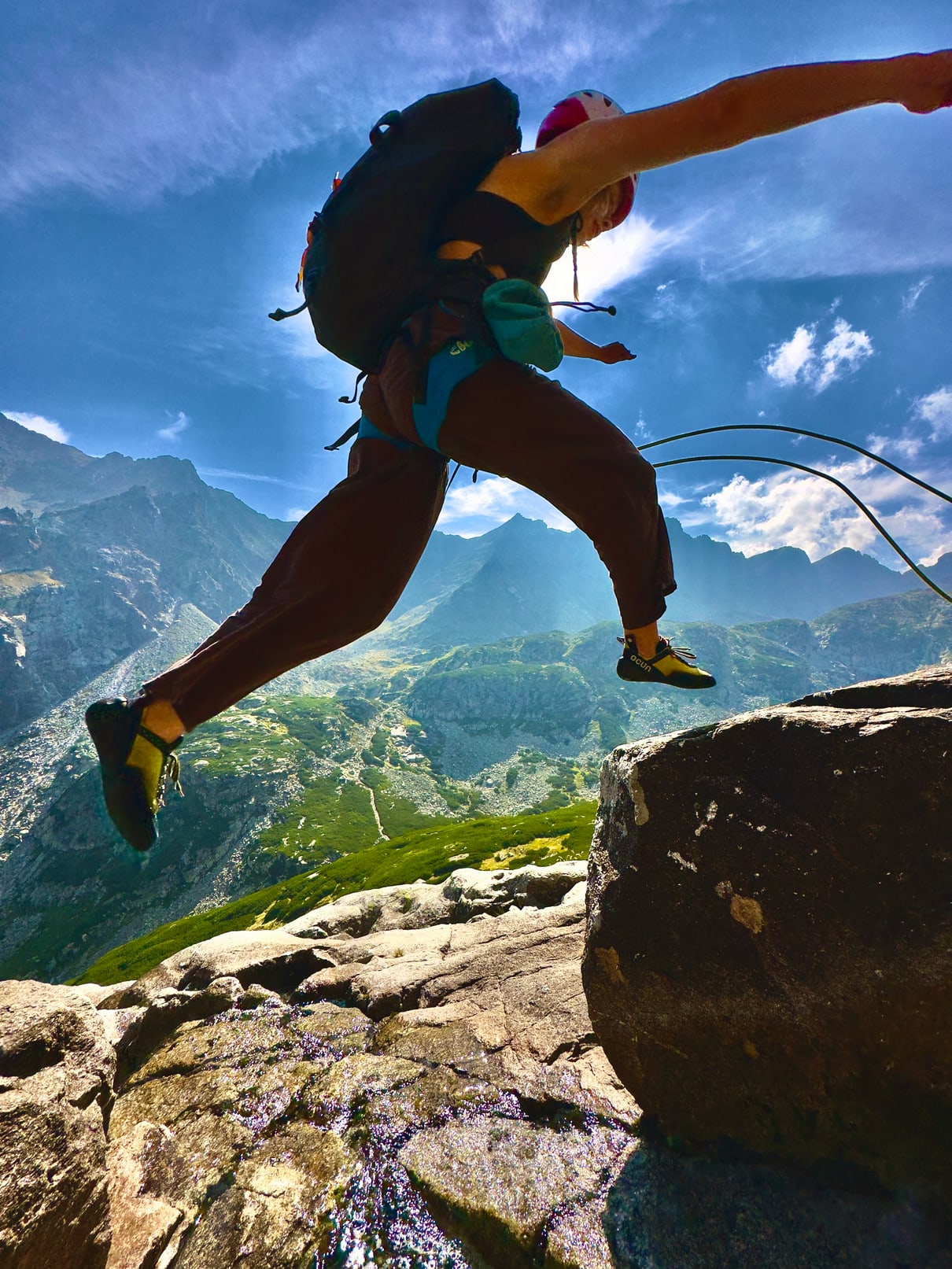
Pitch 6: The Jump, grade CH, 9 m
A jump across the waterfall. The takeoff point is the lower boulder, the landing point the higher one opposite. Try not to get the rope wet while doing it. Climbers can see each other the whole time. Only the desperate or the love-struck fail to notice the anchor in the small wall on the other side of the waterfall.
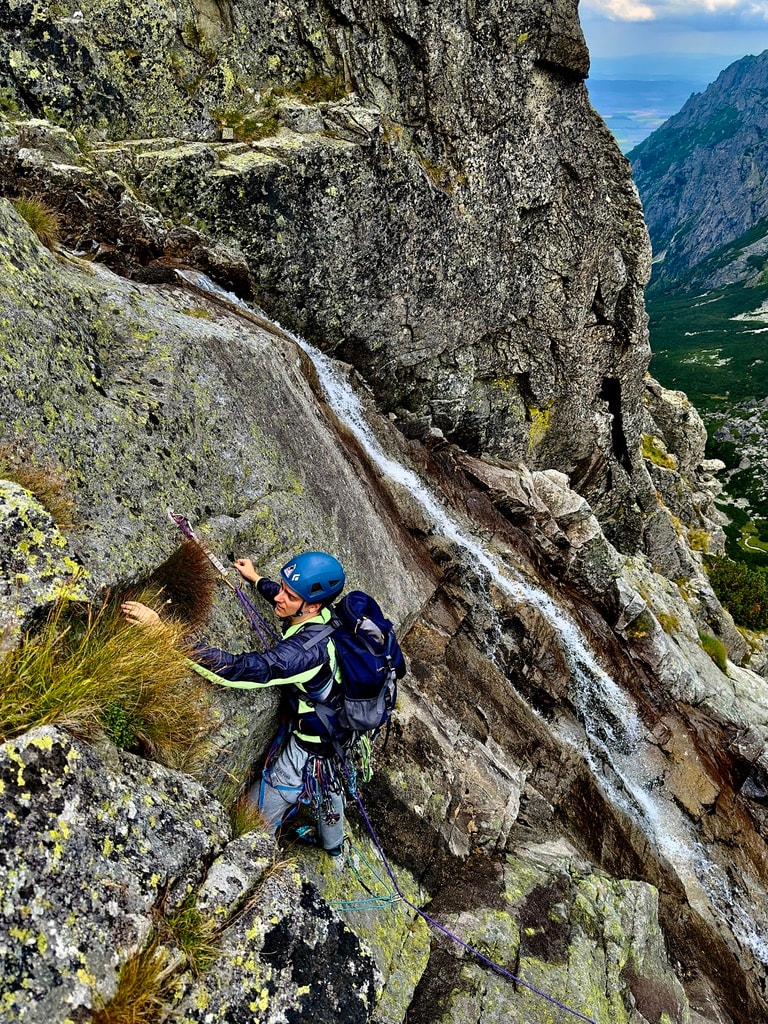
Pitch 7: Vertical Little Wall, grade IV-, 37 m, 1 bolt, 1 piton
Slightly right, then left again, but basically straight up, to below a short vertical section, where this pitch's only bolt sits. Below it are two horizontal cracks with good spots for tiny cams. It's worth placing something there. Once B1 is clipped we climb slightly right and up across a small wall. Above this small wall the wall loses its verticality. We walk along rocky terraces, 10 m up to the right, onto a pillar running right alongside the waterfall. There's a navigational piton here. We keep climbing the pillar, staying close to the waterfall, all the way to the anchor. Don't head into the corner with the unstable blocks to its left! A comfortable ledge to stand on is 4 m below the anchor.
Climbers can see each other only up to the small wall with the bolt.
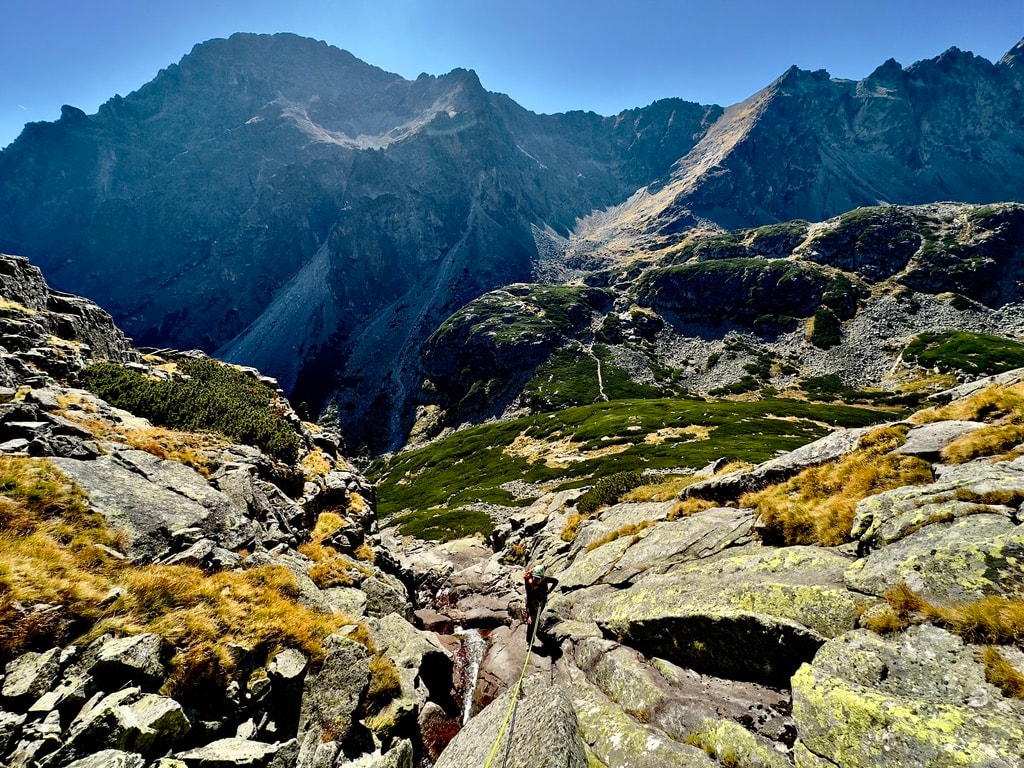
Pitch 8: Prameň, grade III, 26 m
We keep following the pillar, roughly 1.5 m to the left of the waterfall, until it fades into the gully. At the end, gently toward one of the large boulders. On one of them, long slings indicate an excellent anchor spot.
Climbers can see and hear each other. The climber has to build the anchor themselves!
Around the spring itself there are many beautiful spots suitable for a lunch break. The water surfaces here from beneath an enormous rock moraine, which is why it's at its purest right along its whole course. Roughly a hundred metres south of the spring, the terrace also forms a summit. If the climbing team is slow, or if the weather is worsening, for example, it's a good idea to end the climb at the spring. From there you can descend comfortably and safely on walking terrain through Strelecká kotlina. The descent traverse, joining a trail from the start of the last century, is marked with cairns. In darkness, fog, or rain, this trail is harder to make out. From the spring you can also climb to the summit of Strelecká veža on walking terrain. This direction is excellently marked with cairns. From the summit, walking terrain leads to the yellow-marked trail route. Skipping the upper pitches - one of which is grade IV+ - is the best option if the team's climbing ability was already at its limit over the first two-thirds of the route.
Walking terrain between the spring and the final pitches of the route (15 minutes)
Above Vyšný strelecký vodopád begins an enormous rock moraine called Strelecké polia. It's capped by the ridge connecting Ostrý štít and Prostredný hrot. Above the spring, distinct stone cairns on large boulders show the way toward the south-southeast ridge of Strelecká veža. It's a rounded ridge made of grass, rock, and dwarf pines. Roughly at 2000 metres of elevation, the lines split. To the left, southwest, a descent trail leads to the Ostrostrelecká route, marked on cairns with quartz pebbles. Our summit trail climbs to the right. It's separated from Strelecké polia by a shorter east-northeast wall. We continue in this direction, always keeping to the right of the ridge - that is, on its southeast side. If we went left of the ridge (SW), any loose rocks could endanger climbers on the lower parts of the Ostrostrelecká route. The direction of the route is excellently marked with sharp-edged quartz-topped cairns. We walk carefully, since higher up an ESE wall drops away below us. At 2050 metres of elevation we cross south along a grassy ledge separating large, light-coloured, low-angle slabs. Our climb continues up the upper one. It's marked with an anchor bolt and a cairn. The second protection bolt is clearly visible from there. If the grass is wet, we walk with extra care!
Pitch 9: Balcony in the Dwarf Pines, grade IV-, 41 m, 4 bolts
Up a slab and an indicated little pillar below an overhang, B1 (grade III). We go around it via a corner on the left, B2 (grade III), and move into a slab on the left, B3 (grade IV-). From there up and slightly left, B4 (grade III), to a grassy balcony with dwarf pines, where there's a comfortable anchor. This balcony is clearly visible from the grassy ledge at the start. Climbers can see and hear each other the whole time.
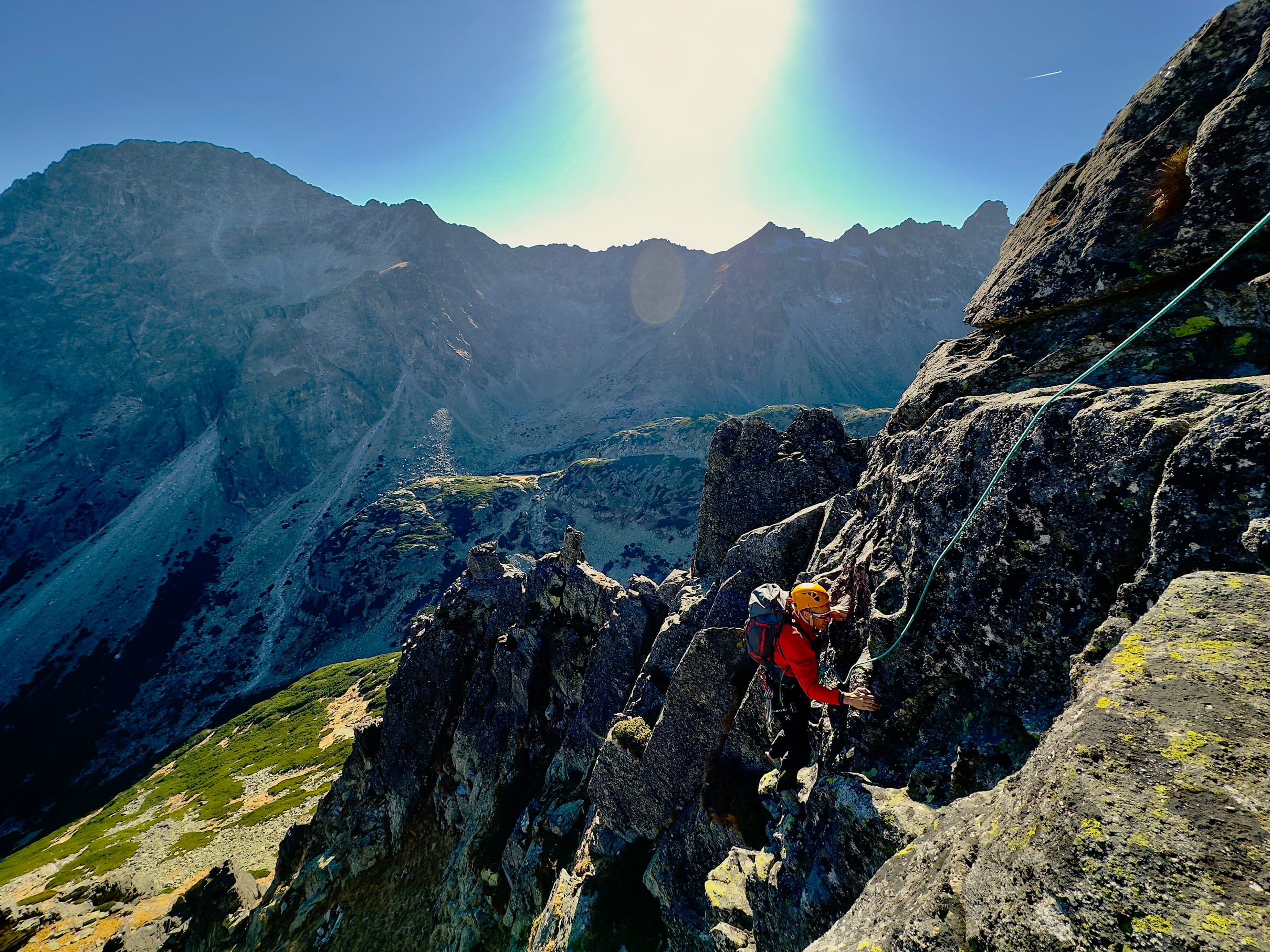
Pitch 10: Dark Diagonal, grade IV+, 30 m, 4 bolts
We climb up to a ledge with dwarf pines (B1, grade III+). From there we continue diagonally left across small walls and ledges, B2 and B3, up to a final small wall below the ridge (grade IV-). Straight up it, B4 (grade IV) and B5 (grade IV+). With every move the pitch gains slightly in both difficulty and beauty. The rippled little wall below the ridge is a fitting finale. The anchor sits on an intimate little ledge. The line, drifting continuously to the left, is shown by the protection bolts. B1 and B2 are visible from the anchor. Sometimes, though, you need to look more carefully for the protection. The first three need extended quickdraws to reduce rope drag. Placing gear helps reduce pendulum swing if the second climber weights the rope. Climbers can see and hear each other the whole time.
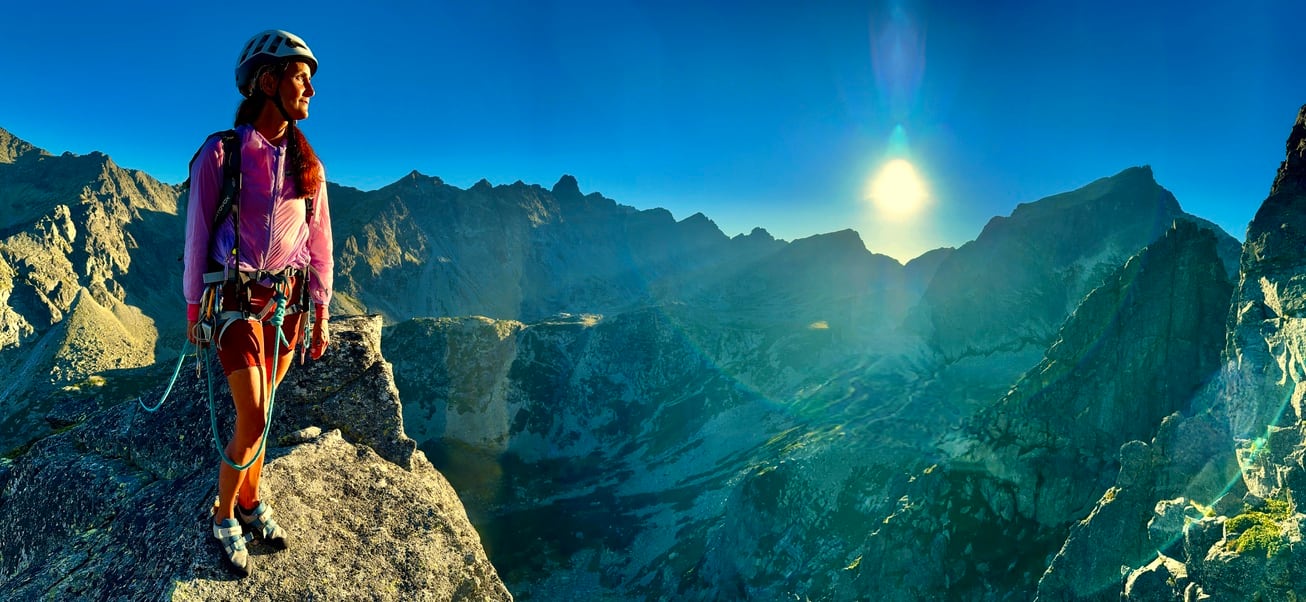
Pitch 11: Summit Ridge, grade III, 30 m, 1 piton
At the same height, to the left of the anchor, is a piton. Above it we climb onto the ridge (grade III). A view west opens up. Along an easy but exposed ridge (grade II) to the right. On the right, on a rock corner, is one anchor bolt. Next to it is a crack for a micro-cam. Climbers can see and hear each other.
Pitch 12: Downclimbing off the Ridge, grade II+, 30 m, 1 bolt
Ten metres along a horizontal ledge, east, below the ridge (grade II+). Then, down a small pillar to the left of a channel, 10 m, into grassy terrain (grade II+). From there, through grass, climbing gently upward to a small wall in a boulder, on which the anchor bolt sits. Climbers can see and hear each other.
Walking terrain from below the ridge to the summit
15 minutes up a large rocky moraine. The summit of Strelecká veža is formed by an enormous rock block resembling a lángoš (fried flatbread).
Descent:
From the summit we walk north along a clearly recognizable little path. After 10 minutes we're on the yellow-marked hiking trail. We continue past Sivé plesá and below Javorový štít toward Zbojnícka chata. At Zbojnícky spád we can leave the marked trail and reach Brána, on the blue-marked hiking trail, via Generálšús.
Time required from Hrebienok
- Approach to the wall from Hrebienok: 1 hour 50 minutes.
- The climb: 5 hours.
- Descent via Generálšús to Hrebienok: 2 hours 50 minutes.
- A full-day tour! Beginners won't make the timing of the first and last chairlift rides.
These times apply to a two-person climbing team. For a party of three, or for beginners, it may take several hours longer!
Gear
- a sit harness and chest harness
- a helmet
- a single 60 m rope, or alternatively 2 x 40 m twin or half ropes
- 6 quickdraws
- 6 locking carabiners and HMS carabiners
- a belay device for each climber
- 4 cams (medium and small sizes)
- slings and a prusik cord
- climbing shoes or approach shoes
- a first-aid kit with a thermal reflective blanket
- a headlamp
- an isotonic drink, or a thermos with warm tea, and food for the field
- clothing to protect against cold and rain
- a mobile phone with a charged battery
- a topo with a route description
Video
This page has been translated using AI and may contain errors.