
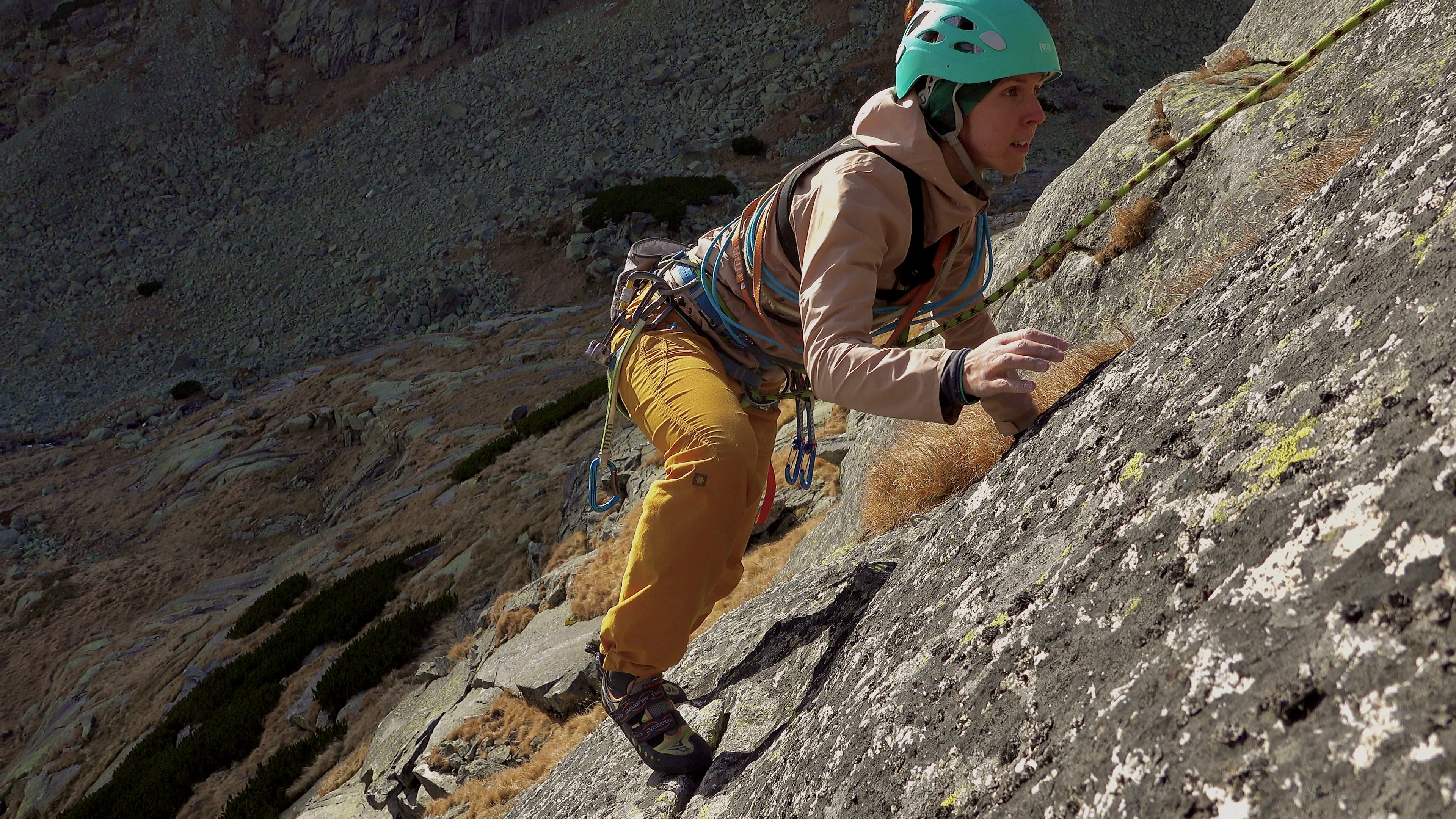
Gabriel, grade VI-, 83 m, Stena archanjelov - Anjelský hang
The archangel Gabriel is the messenger of good news. In this case, that news is entry into grade six, which even in the recent past was reserved only for elite climbers.
His exceptionally beautiful first pitch, unfortunately, puts shorter climbers at a disadvantage. If that's you, take heart - it isn't unsolvable, just pack a quickdraw known as the "long arm" alongside the rest.
Gabriel holds up well in the rain. If the first pitches of Rafael and Michael are wet, its own first pitch opens up access to the higher, usually dry, parts of Stena archanjelov.
Stena archanjelov
Stena archanjelov is the tallest wall on Anjelský hang. Four gorgeous three-pitch routes run up it, from grade V+ to VI+. Climbers who feel at home on crags, on-sighting around grade six, will have an excellent time here. Every harder pitch on the wall is followed by an easier one - though not a completely easy one - so pairs with slightly different ability levels can trade leads here too. Bolts for protection are always placed right before a harder section, or before a spot that would be tricky to protect otherwise. Still, unless you're climbing grade IX, expect to need to place some of your own protection too. Some experience with multi-pitch climbing is needed as well. Climbers have gradually told me that the style of protection on these routes is best captured by the phrase "Jesus bolt" - every bolt shows up exactly at the moment of sincere, intense longing for it to be there. Finding your way on the wall is easy with a topo, and the bolts, appearing at just the right time, help a lot with that too.
Characteristics
Four three-pitch routes for climbers seeking the beauty of climbing from grade V+ to VI+
Stena archanjelov - these are 90-metre routes whose difficulty rises gradually, one increment of the scale at a time. Through the structure of the rock and the creativity that the climbing movement itself demands, the Archangel routes are among the most beautiful things we have in the Tatras.
South-facing
The genuinely enjoyable character of this spot also owes a lot to the south-facing walls. The slope sits high enough above the temperature inversions - the clouds stay below it - while still being close enough for a comfortable trip home while it's still light out.
Approach via Mlynická dolina (1:30 h):
The initial section is the same as the approach to Protiprúd.
Mlynická dolina is one of the most beautiful valleys in the Tatras. Looking more closely from the shores of Štrbské Pleso, its main features are easy to make out: the Solisko ridge borders it on the left, and the Bášte ridge on the right, while Štrbský štít closes it off at the far end. The floor of the valley rises steeply in three steps. The first step, framed on the right by Veža and Stena pod Skokom, is the Skok waterfall. The second is Anjelský hang itself. At the far end, the south rib of Štrbský štít and the surrounding little walls raise the valley floor, forming the Mlynický and Štrbský basins. Between the first and final steps mentioned lies a rocky slope. The yellow trail markers skirt it on the left, past Nižné volie pliesko. At the top of this slope is the start of the easiest route to the highest peak of the Bášte ridge - Satan - and the surrounding place names match: Satan, Pekelník (Hellion), Diablovina (Devilry), Čertov hrb (Devil's Hump), and on top of that, the Horned, Goat, and Ox tarns. But even the ruler of hell was created as an angel, and only worked his way to his current status - as a child of light he used to play with his peers, the angels. Probably only once he traded his wings for horns did his mobility shrink so much that he's stuck poking up out of the valley as a 2,422-metre-tall giant. Perhaps thanks to that, we managed to discover this angelic playground, formed of exceptionally solid, beautifully shaped granite. We named it Anjelský hang. It's made up of Stena archanjelov (90 m), Vežička padlých anjelov (40 m), and Stienka anjelikov (30 m). Nineteen pitches here make up twelve routes, from grade III to grade VI+. All of them can be climbed "light" - no pack, no approach shoes for the descent, and none of life's other accumulated baggage. You can rappel the routes comfortably straight down to the start. For those who want to enjoy the romantic little summit meadows where you can lie down, there's one more bolt at the top of the slope - right above it is an excellent flake, perfect for a 120 cm sling. An ideal combination for an anchor.
In German-speaking areas, a spot like this is called a "Kletterngarten." Well, know that in this little garden you'll find a ninety-metre-high crag facing south. Climbing here calls for placing your own protection, but bolts show up at just the right time, in just the right places. Come try it out. From Štrbské Pleso it's an hour and a half on foot to the base of the wall - a hiking trail marked in yellow, starting at the valley station of the Solisko chairlift. Not all trails are alike, though - judge for yourself: first through the forest, then through a dwarf-pine grove with a babbling stream, past imposing towers, up to a small azure-coloured tarn. Its shore is a beach of white sand. From there, either straight up through the waterfall via Protiprúd, grade III, or along the marked trail to the left around the waterfall, up to the large lake above Skok - Anjelský hang is mirrored in it. Then you have to hop across rocks jutting out of the stream, past a small waterfall, up to Zadná mlynická poľana with its huge boulders. Shortly past the spot where the little stream disappears underground, there's a turnoff toward the angels, marked by a cairn on a boulder. The path is lined with a wealth of mountain flowers - white pasque flowers, yellow arnica, blue harebells, purple soldanellas, and many more. If you don't want to socialize with hikers, set out at dawn - that's when you'll see chamois and maybe even marmots. Two ravens tend to fly above the slope. If possible, avoid starting the approach between 10 a.m. and 2 p.m. Come - the traces of your blueberry-and-jam-stained fingers will fade after your visit, but what you lived through stays forever.
Route description
Pitch 1, grade VI-, 28 m, 3 bolts
The start follows the middle of the slab, over interesting rock features (a good crack for a large cam). Continue up the middle of the slab, friction-climbing past B1 and B2, up to a small crack in a grassy corner, B3. From there climb below an overhang split by a crack (VI-) and through it on holds resembling a dragon's spine (V) - there are excellent gear-placement options here. A slab brings you to the anchor, on a comfortable grassy ledge.
The G1 anchor is clearly visible from the rocks below the wall - climbers can see each other.
Pitch 2, grade V-, 25 m, 4 bolts
Continue straight up slabs, to the right of the grass, B1 (V-). From there, climb a pleasantly angled slab with horizontal ripples up to B2, set in a white patch of rock visible even from a distance (IV+). Then follow the line of a "dragon crack," free climbing, up to B3 and B4, onto a small, flower-covered balcony where the G2 anchor sits.
G2 is visible from G1 - climbers can see each other.
Pitch 3, grade V+, 30 m, 5 bolts
Climb a rounded pillar with a diagonal anchor chain to the right, to the left of a grassy corner, B1, B2, B3 (V). Two metres above B3 there's a horizontal little crack for a micro-cam. Traverse left here into a corner that's now free of grass. Continue up the corner, which has a crack for large cams, to the right, to B4, and from there up a cascading wall to the left of the corner (V+) to B5. A vertical corner (free climbing) brings you to the G3 anchor.
G3 is visible from G2 - climbers can see each other.
Above the G3 anchor, at the top of the slope near the small meadows, there's one more bolt. Right above it is an excellent flake, perfect for a 120 cm sling - an ideal combination for an anchor, for those who don't want to rappel down the wall.
Descent by rappel, or via the trail using the yellow markers:
From MK3, rappel past the huge boulder to the K2 anchor. From there continue to MK1, and down to the ground.
Knots at the ends of the ropes are essential when rappelling!
The descent via the trail takes about 15 minutes.
Time required
- Štrbské Pleso – Anjelský hang: 1 hour 30 minutes
- The climb: depending on which routes you choose, climbing all the archangels takes around 5 hours
- Return to Štrbské Pleso: 1 hour 30 minutes
- Total: 8 hours
These times apply to a two-person climbing team. For a party of three, or for beginners, it may take several hours longer!
Gear
- a sit harness and chest harness
- a helmet
- a single 60 m rope
- 10 quickdraws
- 2 x 120 cm slings
- 4 locking carabiners
- 2 locking HMS carabiners
- a belay/rappel device for each climber (for example a Gigi or a Jul)
- 10 cams - basic as well as small sizes, or nuts with a nut tool
- climbing shoes
- a first-aid kit with a thermal reflective blanket
- a headlamp
- enough fluids
- food for the field
- clothing to protect against cold and rain
- a mobile phone with a charged battery
- topos and route descriptions
History:
The first ground-up traverse of the entire slope, combining today's routes, was done by Martin Murár and Braňo Stavný in the autumn of 2020. Ground-up ascents of the remaining individual pitches, done piece by piece, were gradually completed by Michal Dzurilla and Martin Murár in the spring of 2021. The first on-sight ascent of the Rafael-Gabriel-Michael trilogy, plus the Cez krídlo bonus pitch (11 pitches total), was climbed by Zuzana Božiková in the summer of 2021. We climbed and worked on the slope in alternation through June and July 2021. A huge amount of unpaid work was put in by Michal Dzurilla, Martin Zbuška, Michal Murár, and Zuzana Božiková. The whole project was made possible by 2% tax donors through the Ta33 Climbing Manifesto appeal - our heartfelt thanks! It wouldn't have been possible without their support.
There are more lines between the archangels - all of them can be climbed on top rope. It isn't hard to discover your own unique angel among them. If you're ever tempted to add bolts anywhere along these lines, please talk to us about it first.
A short reflection on Stena archanjelov
Angels are beings made of light - intermediaries between God and humanity, direct participants in God's plan. They protect people, and that goes double for climbers, since, like it or not, a climber is only human too. Angels are described in belief systems from ancient Egypt right up to the present, and among them, the archangels are the ones closest to God. That much is evident just by looking at Anjelský hang. As I write these lines, I already have more than 33 years of climbing and ski mountaineering behind me, and based on certain sources, that seems to be long enough a stretch even for the world's salvation. The number of my ascents in the mountains has long since passed four figures. I've always tried to act responsibly - though of course, especially in the early days of my climbing career, there was room for improvement there too. What I can say for certain, though, is that no group of gamblers would take me on today. I keep learning, and I do something that might distantly resemble training. I choose appropriate goals. And yet, despite all of that, I know there were situations I wouldn't have made it through without help from above and its angels - and not just me, but some of my close friends, or even my closest ones. It isn't a matter of one single, exceptional turning point - there were several. So I remain in their debt. I try to learn from that, and I keep it in mind even when we're building new routes. From time to time I meet someone who says: "Bolts are too safe, they don't belong in the mountains." Or: "If you can't handle it, don't go to the mountains." But every one of us, past a certain level of strain, can't handle it - and that limit is set completely differently for each person, isn't fixed, and changes over the course of a life. Mountaineering offers a unique chance to get to know that limit with absolute intimacy, and knowing it is key to a person's life. But not everyone starts doing something about it, not everyone who does holds out, and not everyone who holds out survives. In the mountains we're a little closer to God - they have that mysterious power to make us better people. So they should stay open to everyone, so that each person can find their own path in them - with bolts, or without them.
This page has been translated using AI and may contain errors.